This is not typical isekai. Actually it’s way off the ordinary isekai track. Most isekai shows are subjected, sometimes unfairly, sometimes not, to the charge of being very cookie-cutter, sharing too many characteristics, to the point that one seems very much like a copy of the next. Mushoku Tensei: Jobless Reincarnation definitely does everything it can to buck that label. […]
This is not typical isekai. Actually it’s way off the ordinary isekai track. Most isekai shows are subjected, sometimes unfairly, sometimes not, to the charge of being very cookie-cutter, sharing too many characteristics, to the point that one seems very much like a copy of the next. Mushoku Tensei: Jobless Reincarnation definitely does everything it can to buck that label. And it does a really good job not only with that, but with many other things along the way. I like it.
This show is different, refreshing, edgy as hell, heartfelt and powerful at times, at times annoying (and by that I mean one particular character only…read on), but always engaging. I picked this anime up once I saw all the hype around part 2 of season 1—and, admittedly, after seeing the ten thousandth fanart of Ghislaine—and I was never disappointed. If you like your isekai a bit on the atypical side, this show is definitely for you.
A bit of R-rated stuff in this review, so be advised as always.
Material covered: One and a half seasons (three parts), 35 episodes.
⭐⭐⭐⭐
Rating: 4 out of 5.
Characters
Rating: 8
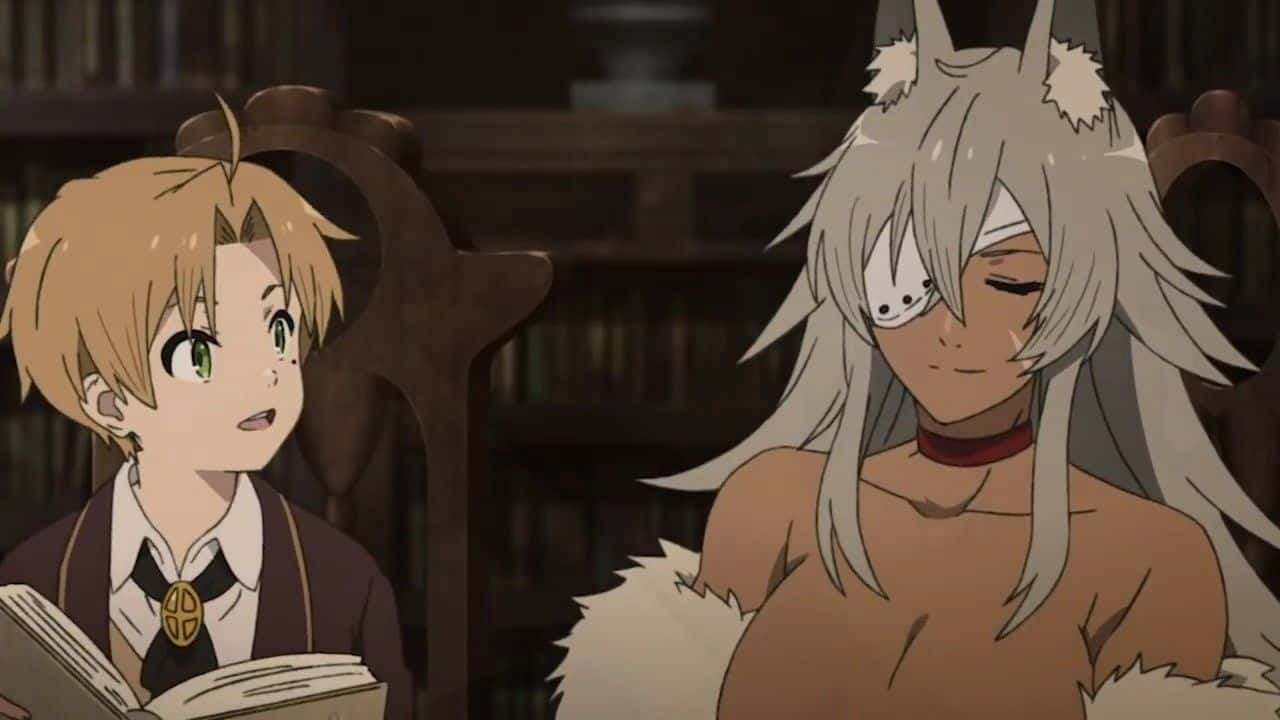
Yes Rudeus is the main character. And I like Rudeus. Sort of. But I really like Ghislaine.
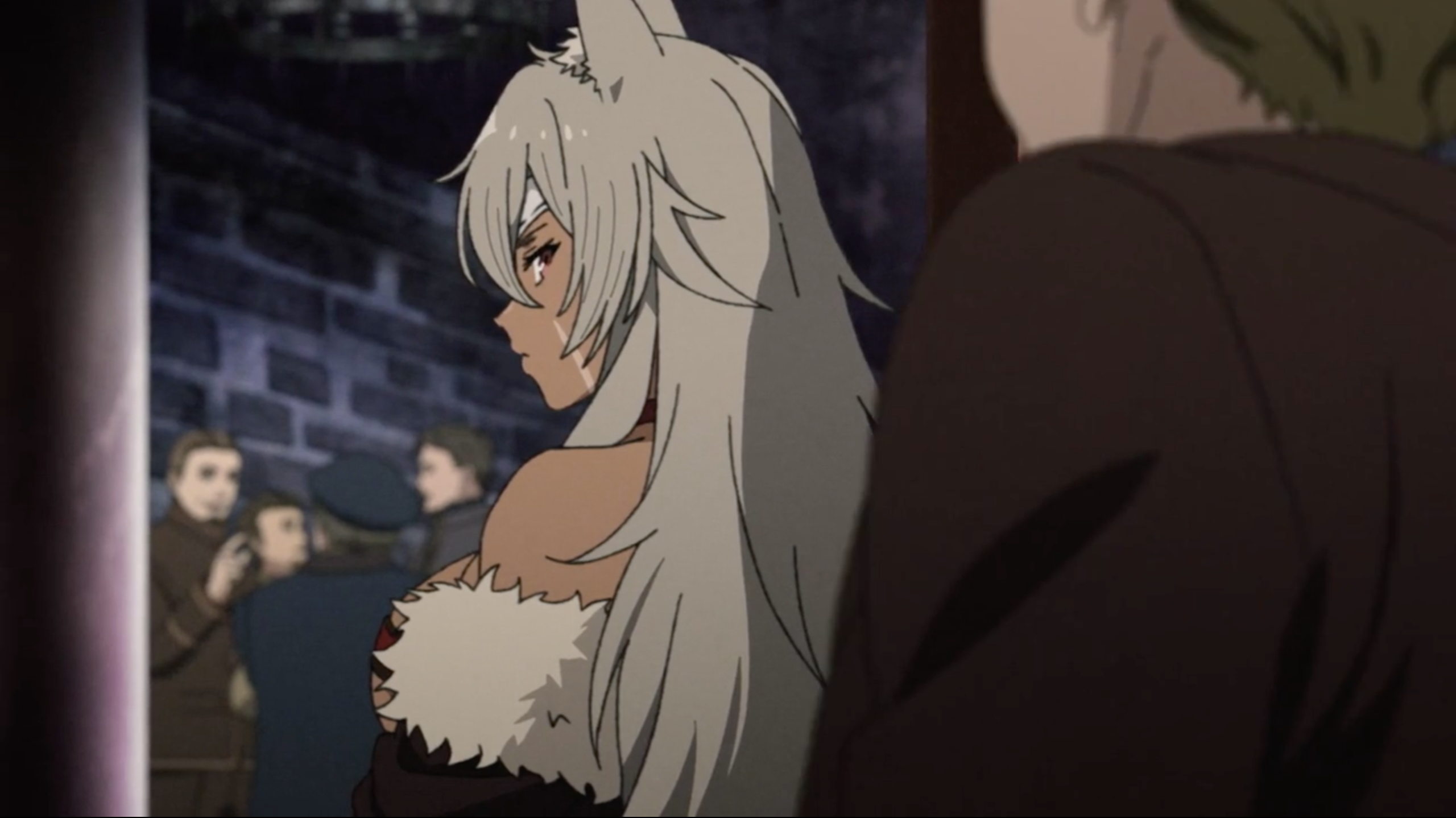
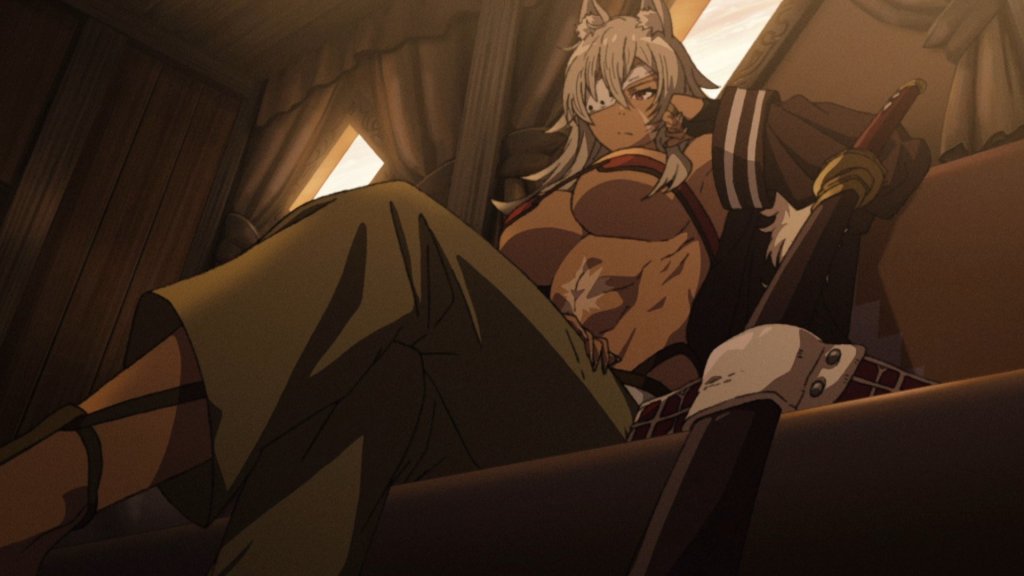
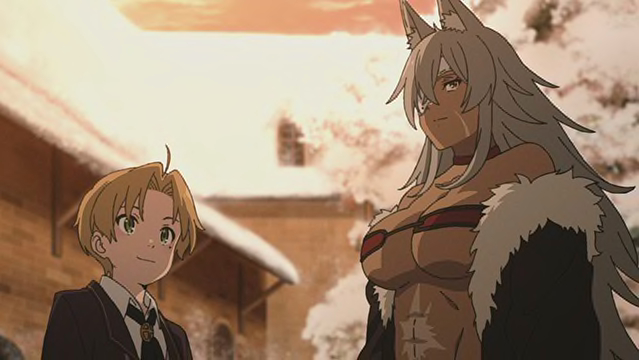
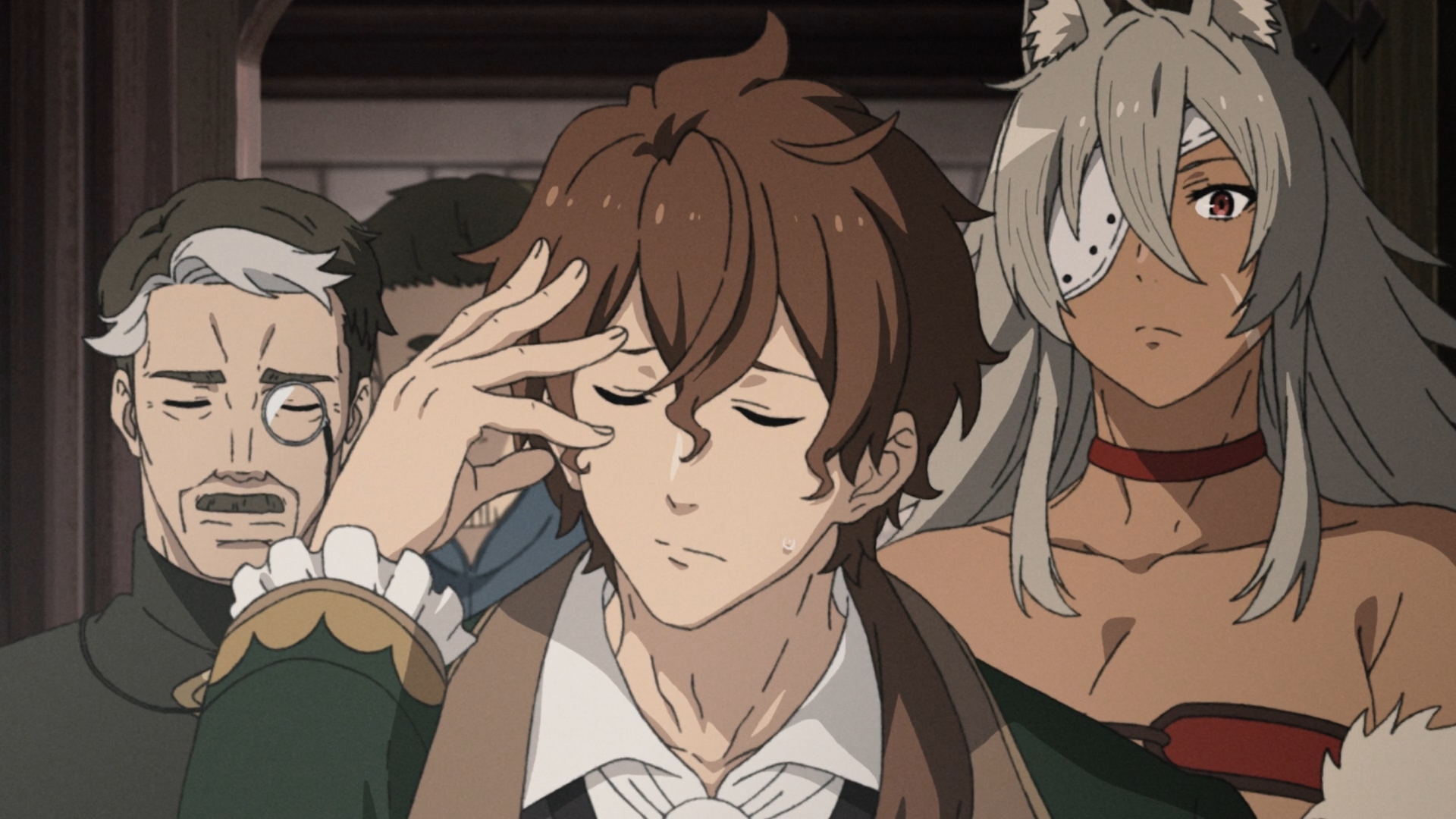
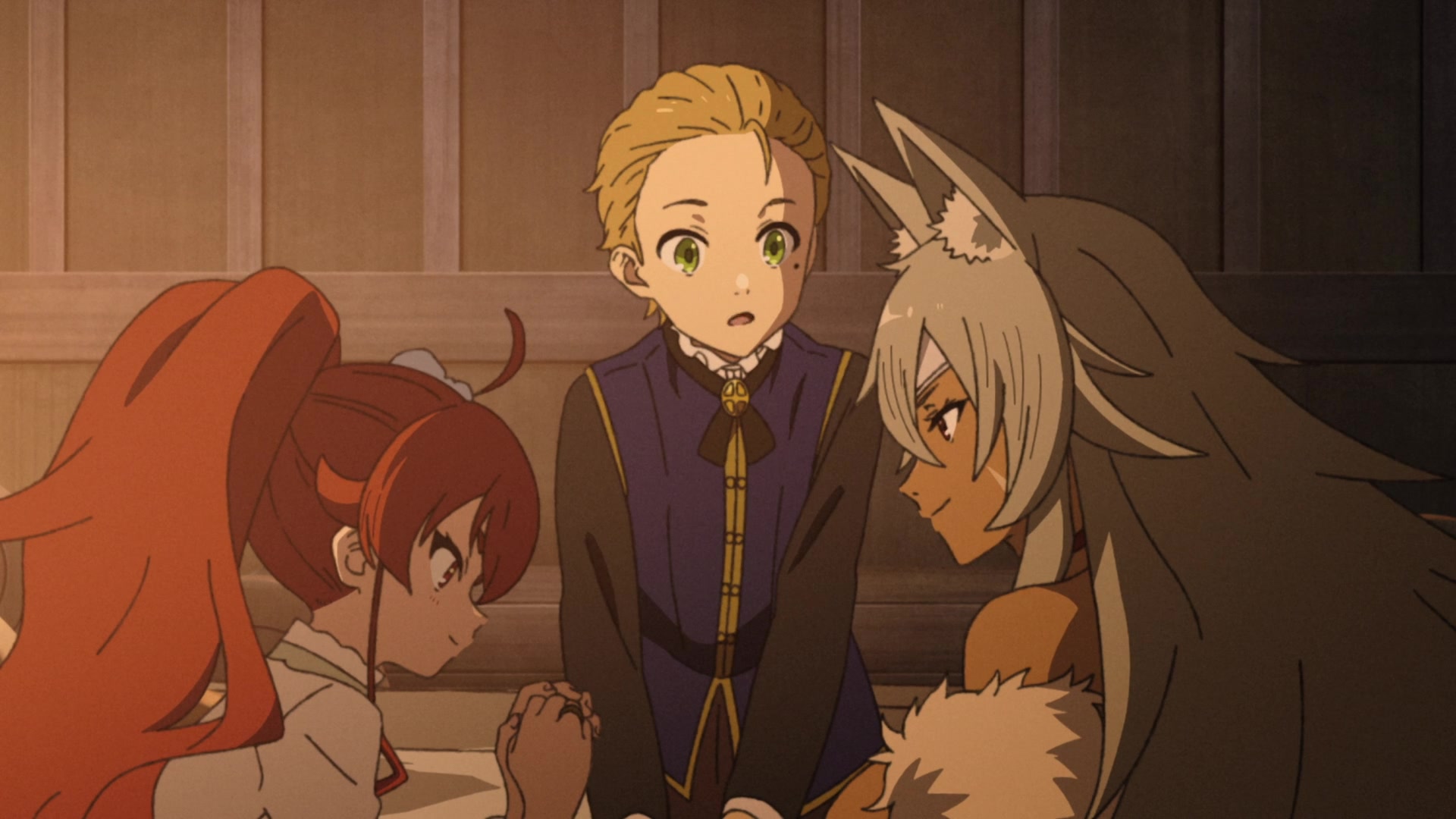
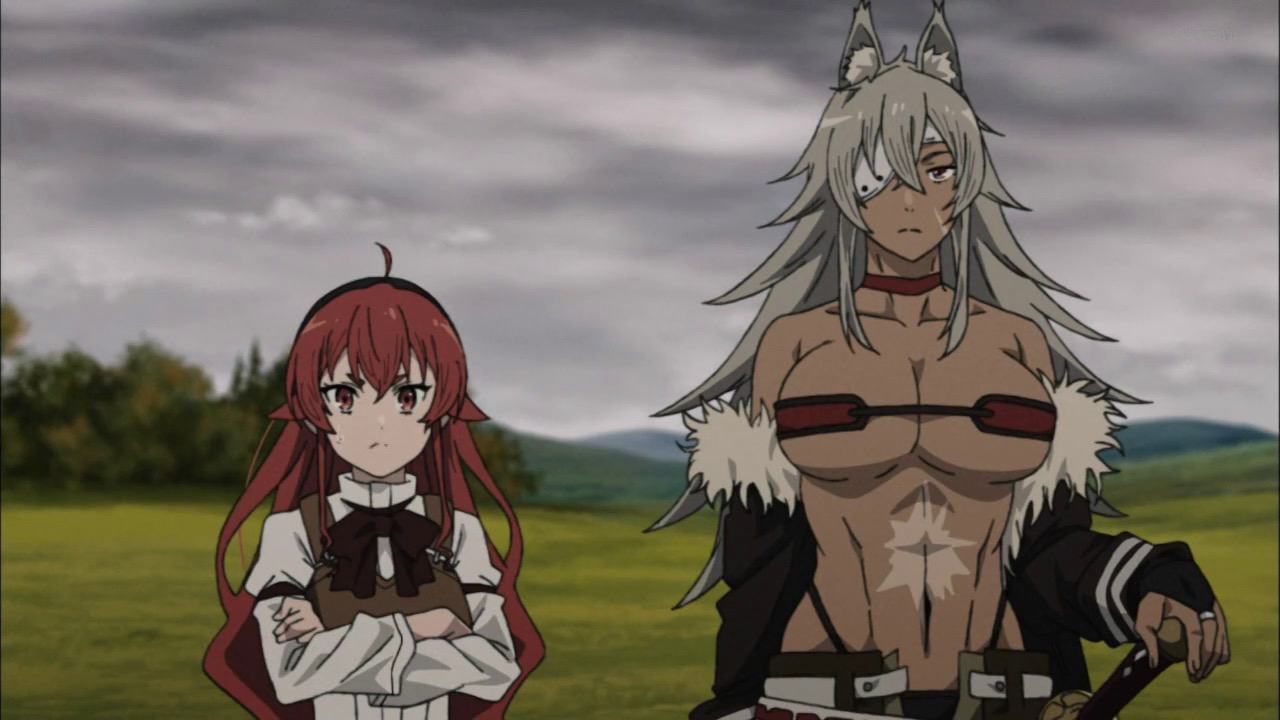
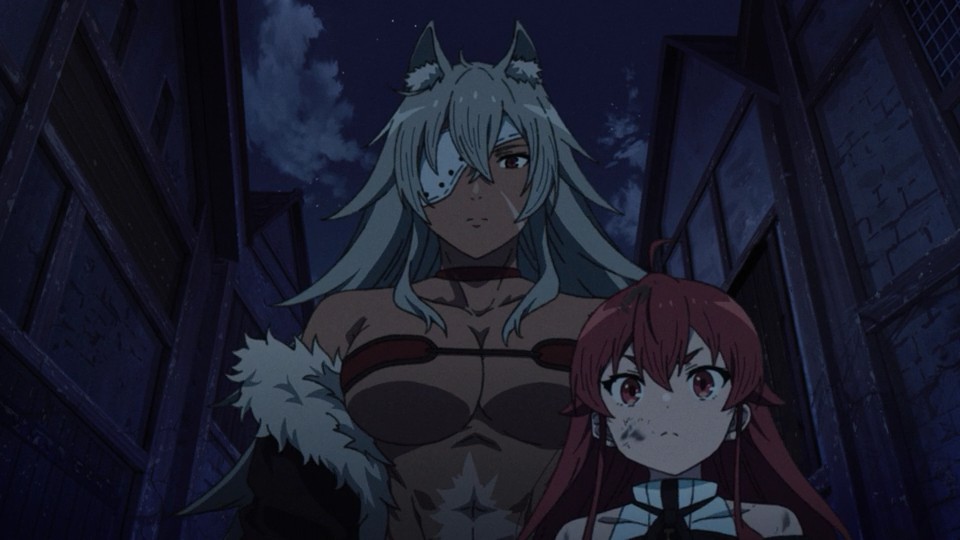
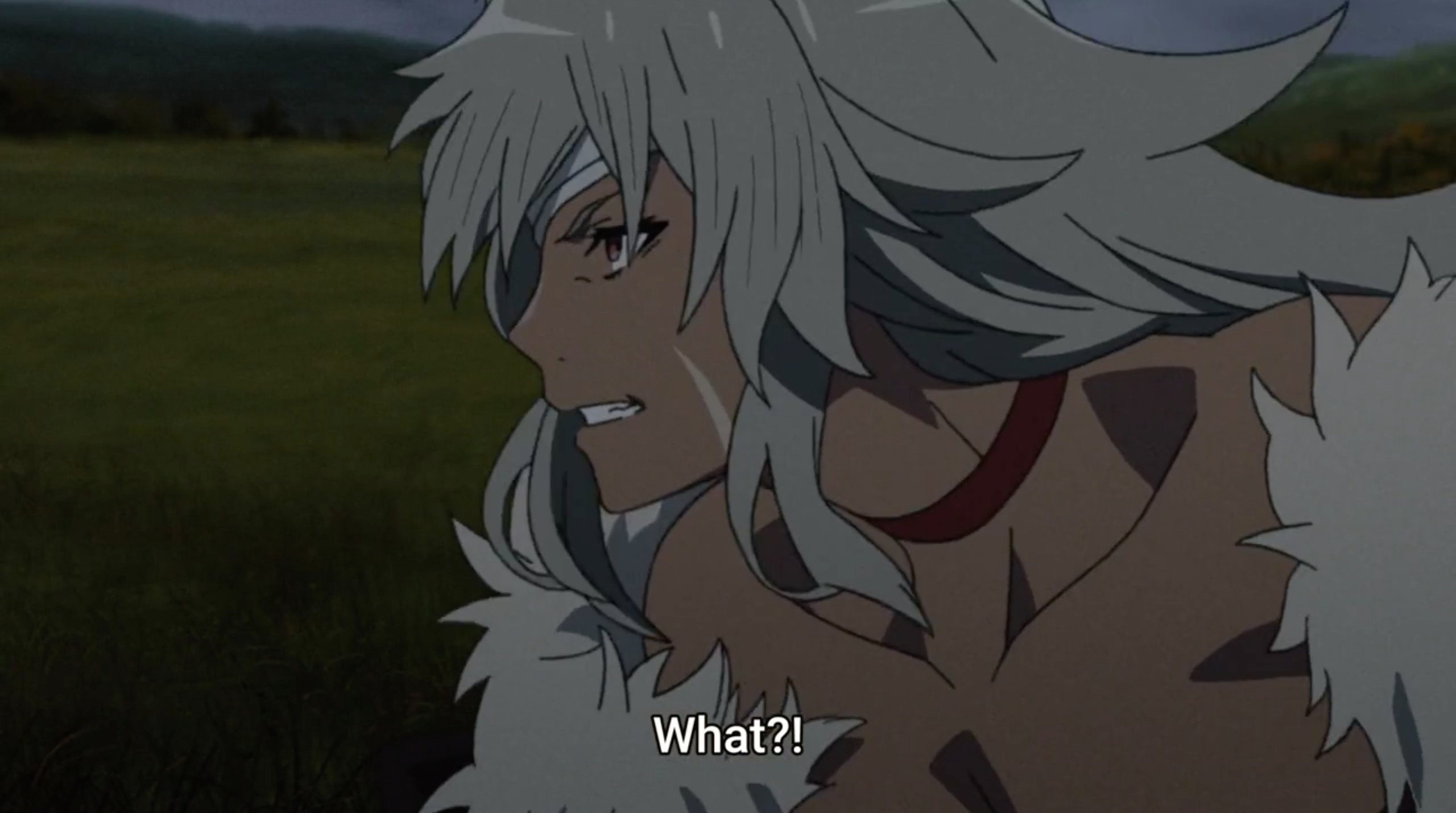
Alright…fan service. This show is highly lewd in many respects. The author is probably a highly lewd human. Be that all as it may: Ghislaine will make you sweat. That’s a body. She’s sexy as hell and doesn’t even act like it. But her behavior and mentality are some of my favorite parts about her. I love how strong she is. Physically yes, but her personality is also very strong, and she’s a warrior. I love these types of characters.
When I first saw Ghislaine in my travels around the Internets and realized she was from this show, I said to myself, says I: I see what I like, and I like what I see. Then I began watching this show and I loved that deep voice that went with this visually stunning character. It tickled a memory somewhere in my brain. I looked up the voice actress. It was Megumi Toyoguchi. Oh ok, as in one of the two voices for Winry from Fullmetal Alchemist and Junko Enoshima from the Danganronpa series, and some other miscellaneous anime roles. And Revy. From Black Lagoon.
Revy!
Yes! This character went from solidly on my radar to absorbing my attention. I love that deep, threatening voice that oozes with “I don’t give a f**k.” So while there isn’t anything really much to this character (at least through two seasons) between her heart-stopping appearance and the godlike voice of Toyoguchi-san, I was enthralled. It was great to hear that voice again.
It makes me shiver with thoughts I cannot say.
Ghislaine’s banter with Rudeus is really good too. These two are played by solid veteran VAs (more on Rudeus in a moment), and they do a great job conversing as characters. They both look at each other familiarly but curiously. It’s fun watching and listening to them interact.
I almost went nuts on the studio and producers when Ghislaine was absent for all but the last episode or two of the second half of S1. That would have been a crime against humanity, to deprive audiences of that experience completely for the remainder of S1. I was glad when she returned. Unfortunately we only saw her briefly in S2 as well, but I have a feeling she’ll be involved in this story again before all is said and done. I look forward to that.
Having started with all that: the characters in this show are all kinds of wild. Ghislaine is a tiny little part of that, as absorbing as she is. There are many stars in this rather curious sky that is the cast of Mushoku Tensei.
So this Rudeus guy, like most of the characters in this show, gets the wheels turning in my head. So let’s do an episode of the Good, the Bad, and the Ugly, which, in this case, really means: the good, the curious but interesting, and then the bad.
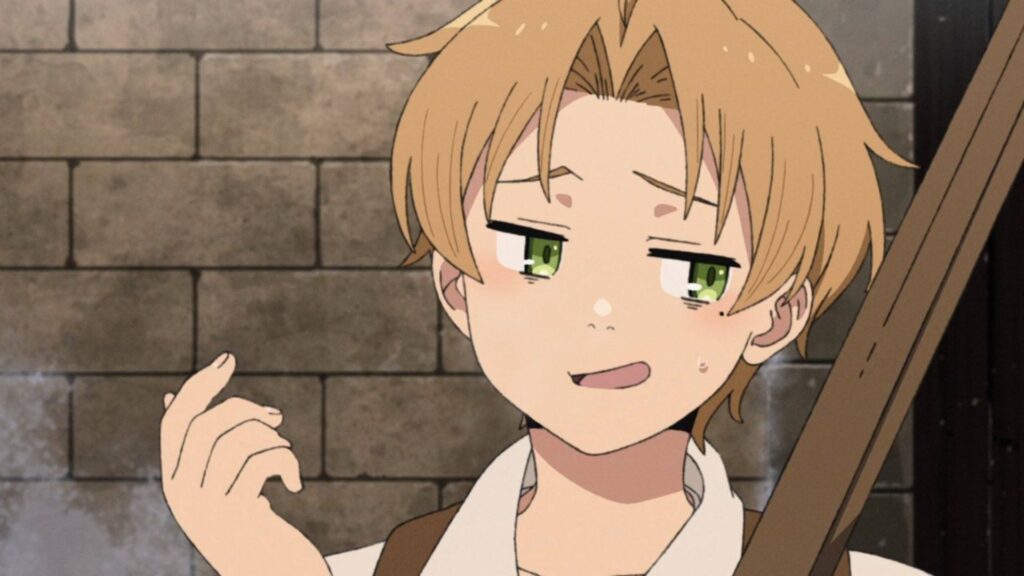
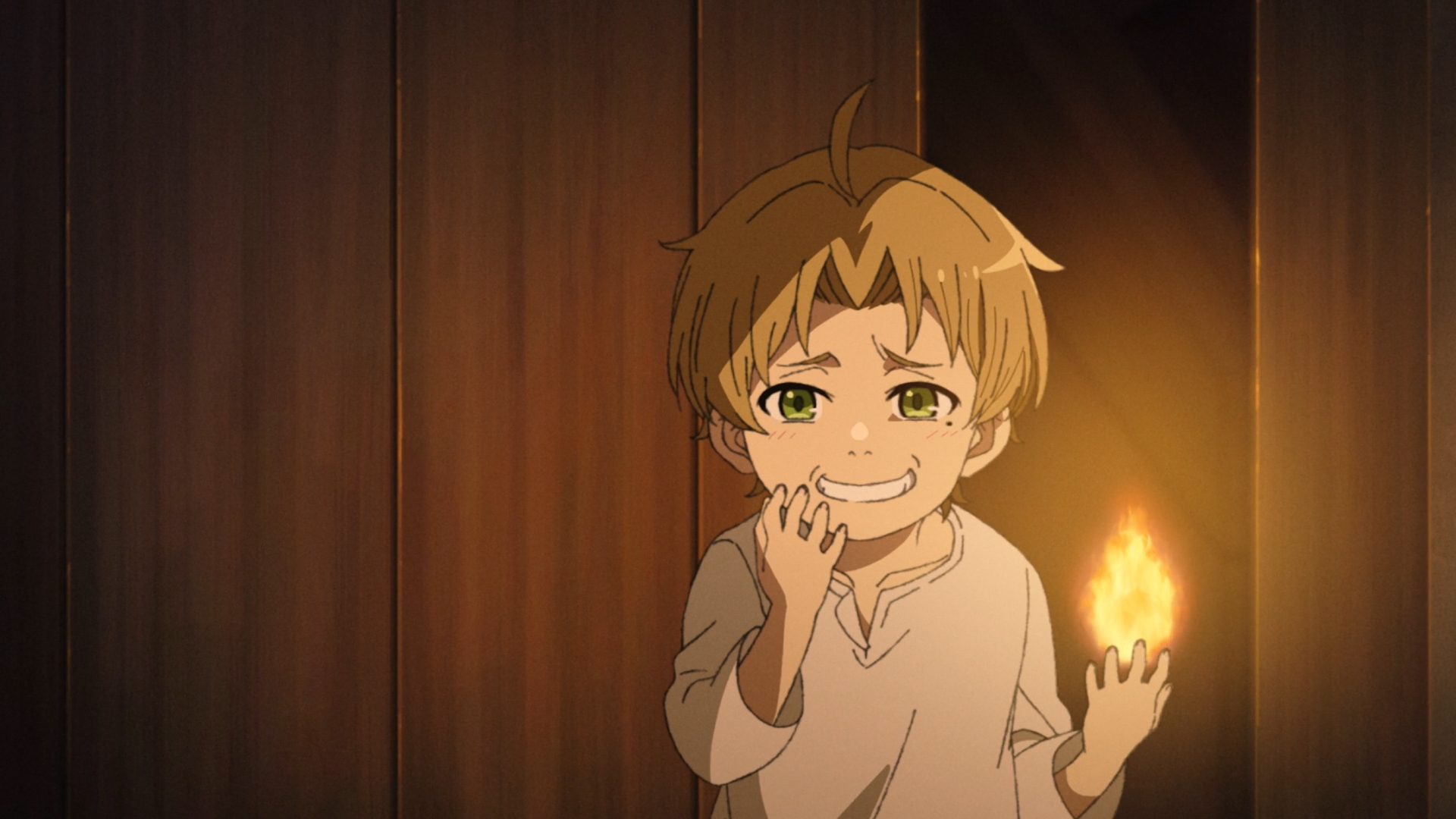
The good is that Rudeus is nowhere near your typical isekai protagonist. I think the writers did everything they could to avoid those tropes. Rudeus is a kid, true, but he’s clearly a kid. There’s no No Game, No Life Sora or SAO Kirito here, where they’re fresh out of class and ready to conquer the world with sword and brain and brawn. He does do the shut-in thing in his previous life, but that’s one of a very few typical tropes I easily see here, and based on what I see in other areas from the writers, there’s probably a good reason they employed this trope, or at least there’s probably some thought behind it. So he’s not typical, and I always like that kind of thing. It shows awareness and thought from the original author and the screenwriters for the anime.
These two together are almost as good as Rudeus and Ghislaine.
The bad (the curious but interesting) is kind of general, something I’ve noticed elsewhere before, but is so remarkable to me with this character that I feel obliged to bring it up in regards to Rudeus. Most avid anime fans are familiar with English-to-Japanese phonetic issue of the letters R and L. As in, Rudeus becomes Ludeus by pronunciation, Revy becomes Levy, Rintaro becomes Lintalo, Lily becomes Riri, Rory becomes Loli–oh, fascinating, fans of Gate; see the kinds of things we discover here?—etc. Right, this happens a lot in anime and usually is coincidental. I’m going to go way out in the woods here for a minute, but bear with my ramble (lamble?).
If there’s any meaning behind “Ludeus,” it could come from several different places. Here we go into the woods boys and girls. The word “ludi” is Latin for “game” or “sport.” Latin? As in the Romans? Yes, that. While there’s no actual word “ludeus” in the Latin language, as some of you will know, Latin uses roots and endings to create meaning in words. “Lud” (pronounced “lood” like “food”) is the root here. Coincidence?
Hawk you’re crazy, that’s ridiculous. And how does that have anything to do with Rudeus? Some odd reference to the connection between isekai and gaming? Really? Truth be told: yes it is ridiculous, and I don’t think it does mean anything for Rudeus. Nor do I want to spend a bunch of time trying to figure out some exotic reason why there might be some connection here. The only reason I even bring this up is the rather Romantic (as in Romans, not love) choice of name in the first place, Rudeus. Would a Japanese author play a word game with a Latin word? Probably not, but the thought is curious and interesting.
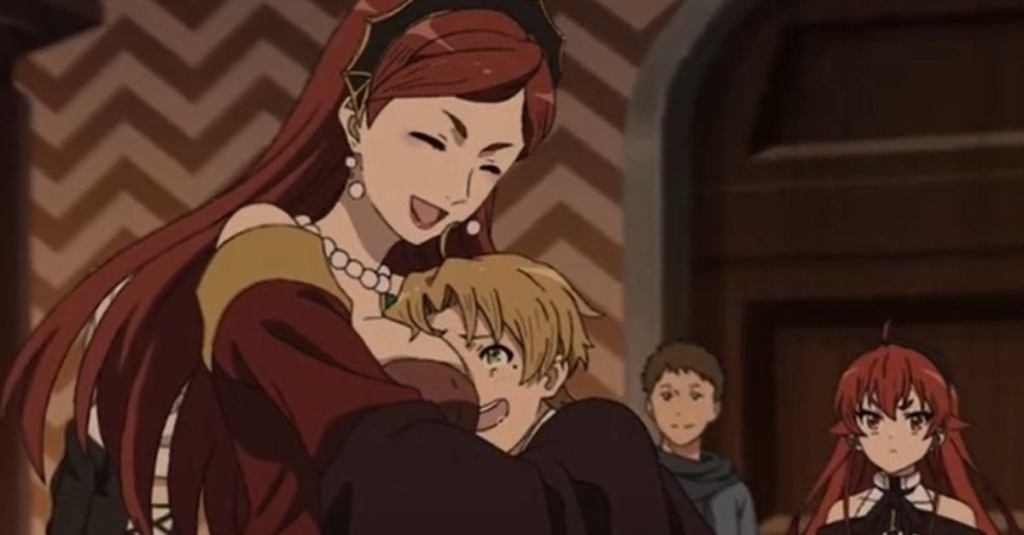
Eris’s mom gets a little too enthusiastic, and Rudeus loves it.Kono hentai.
Or it could play with the English word “lewd.” Among foreign language wordplay possibilities, this seems more likely. And this is the finest transition ever! Time for the ugly! The horni boi who’s really a good guy at heart thing simultaneously peaked and got old with Araragi in Monogatari. I get it there. I don’t get it the bazillion times it’s happened since then in male anime protagonists. Once again, perhaps there’s something to the fact that I noticed it with this character where normally it’s just kind of there with any other character, similar to the R and L thing above. But my big problem with it here ties into the good thing I noted about Rudeus: he isn’t typical. Why pick something as boorishly typical as the pervy good guy as a character trait for him? It seems an odd contradiction.
But above all, I like the voice acting for this character. The VA doing Rudeus’ child voice, Yuri Uchiyama (child Rei, March Comes in Like a Lion; Puck, Re:Zero) has to take into consideration how Rudeus is in his subconscious, making her task somewhat tricky, and she does a great job with it. Because the subconscious Rudeus is still the Rudeus from our world, even when he was a baby in his new life and couldn’t talk. That Rudeus is played by the magnificent Tomokazu Sugita. Yep, Gintoki from Gintama. It’s everything you’d expect from that deadpan voice. Subconscious Rudeus is fantastic. Whoever cast him in this role is a boss.
Rudeus’s romantic encounters are a very prominent part of his character. They played a role in S1, but really began to take center stage at the conclusion of S1 and then dominated S2. The thing with Eris was powerful for a number of reasons, which I won’t get into here because it will take up too much time. Suffice it to say that I thought that was a very effective part of Rudeus’s character development and a nice piece in this story. But it also set up the situation that hung so prominently over S2, pun intended: Rudeus experiencing erectile dysfunction. I’ll get into this more in the Story section. It pretty much defines everything that happens in S2 and helps develop Rudeus as a character along the way, albeit it’s a bit much in some ways.
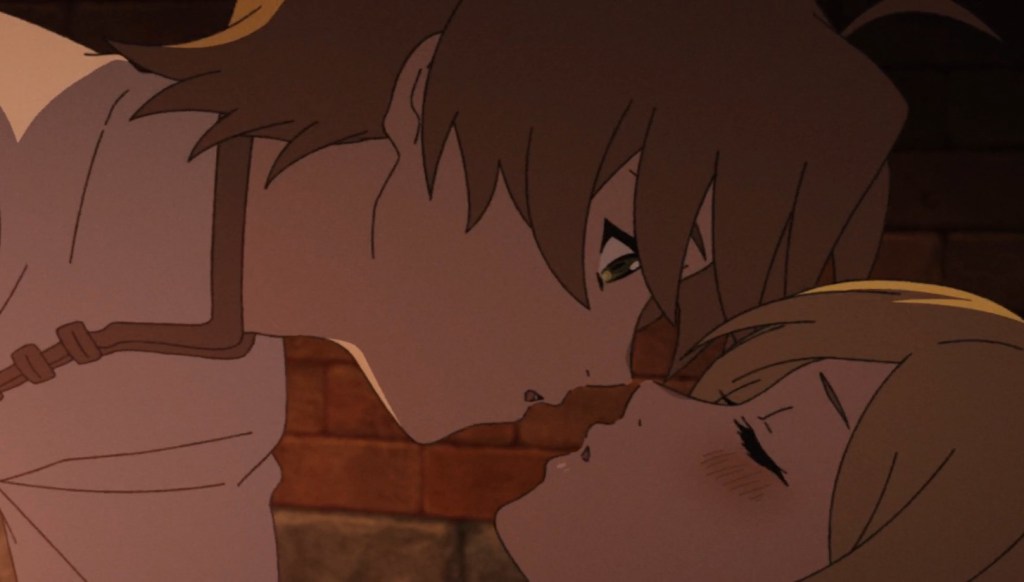
Rudeus and–Fitz–meet in S2. Things get heated. Yes, in that way. Wut?
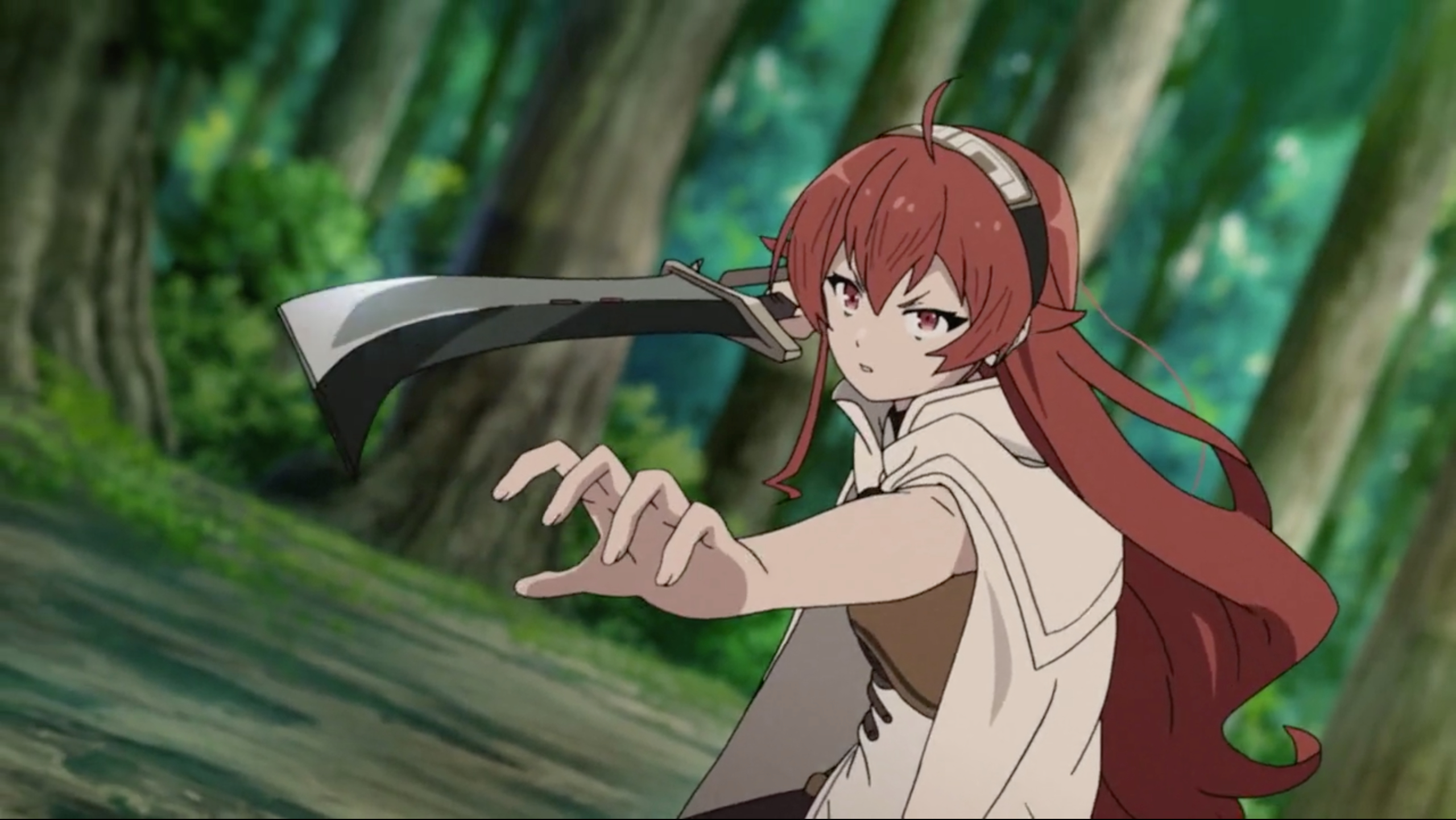
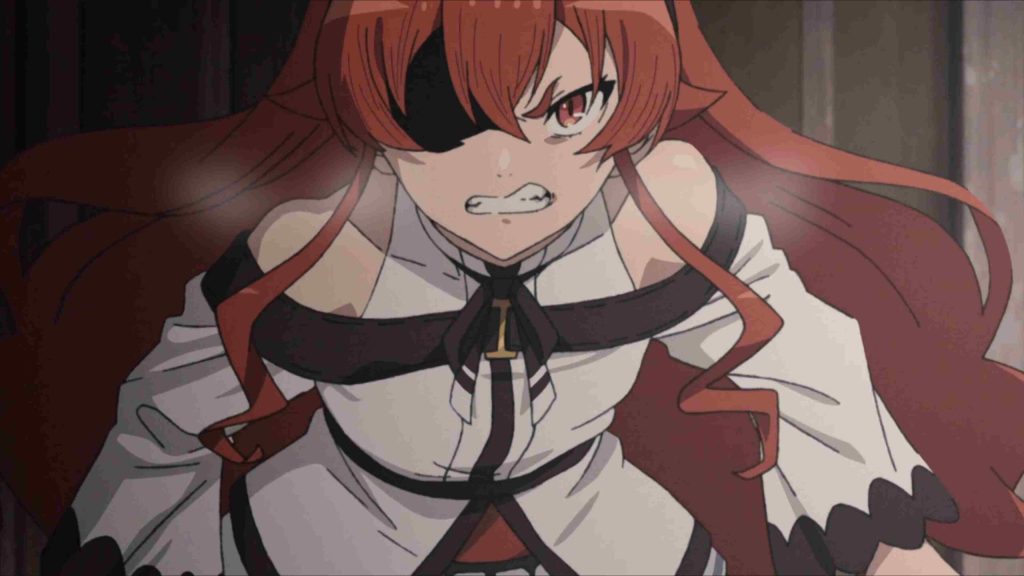
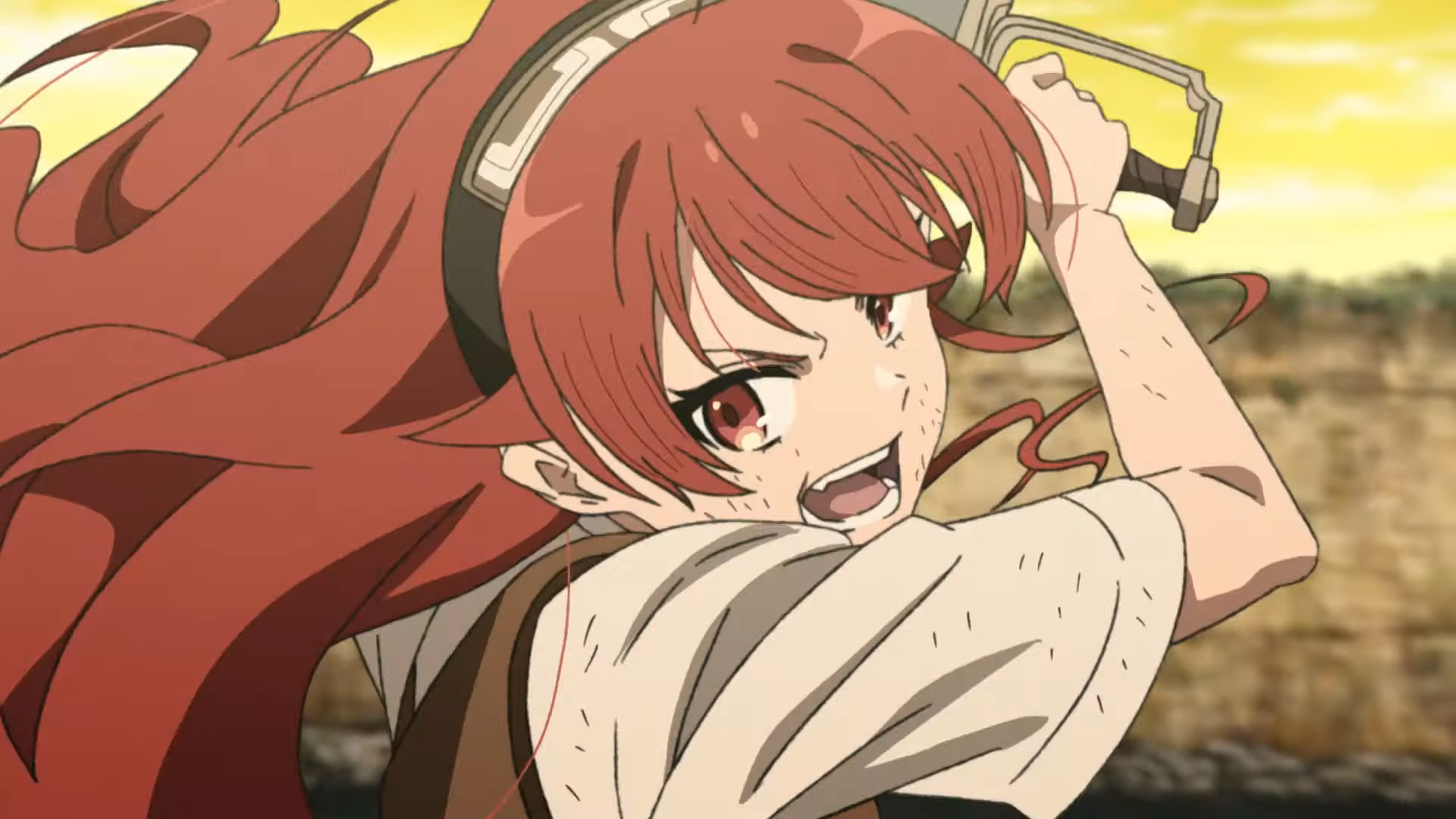
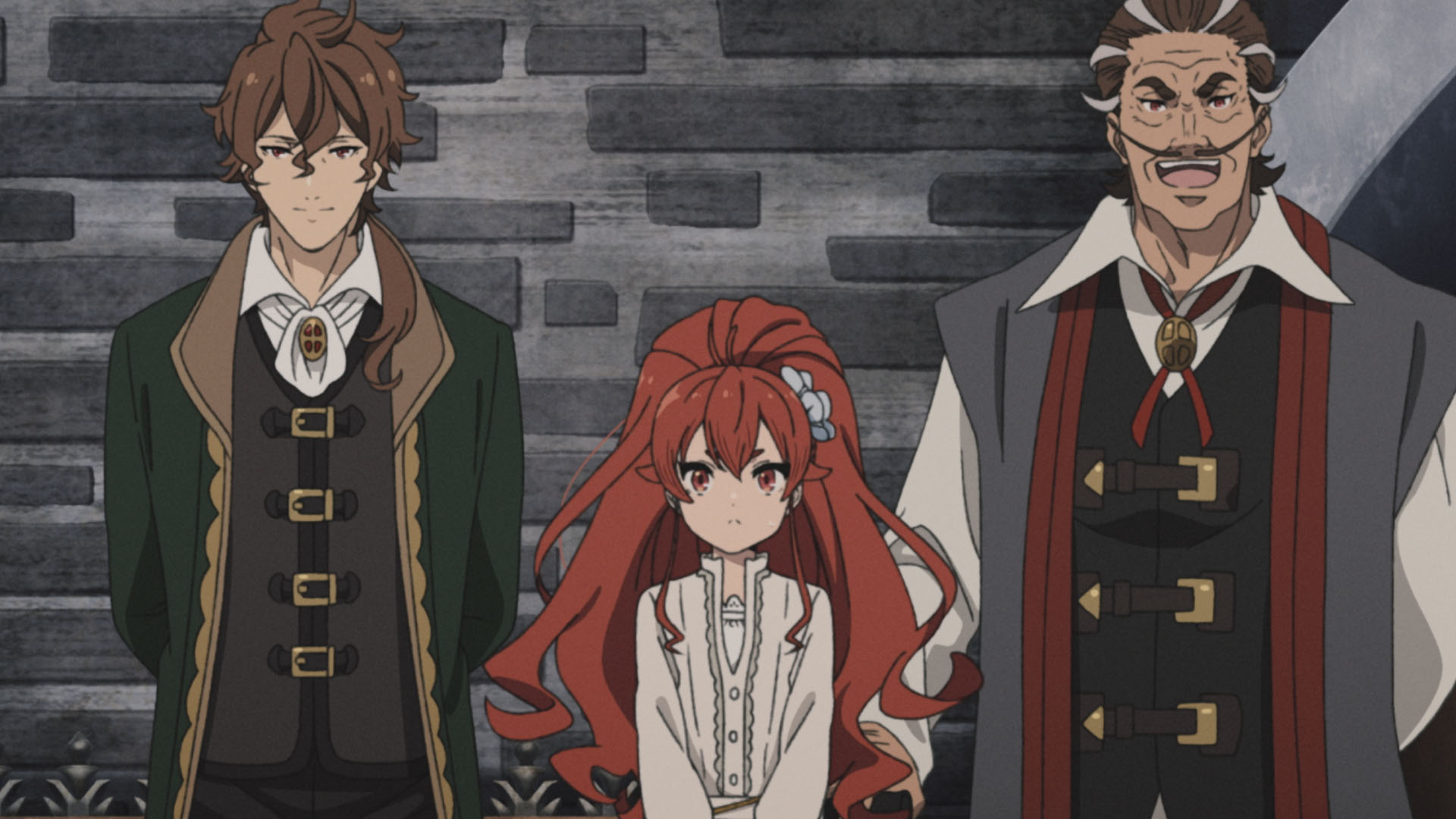
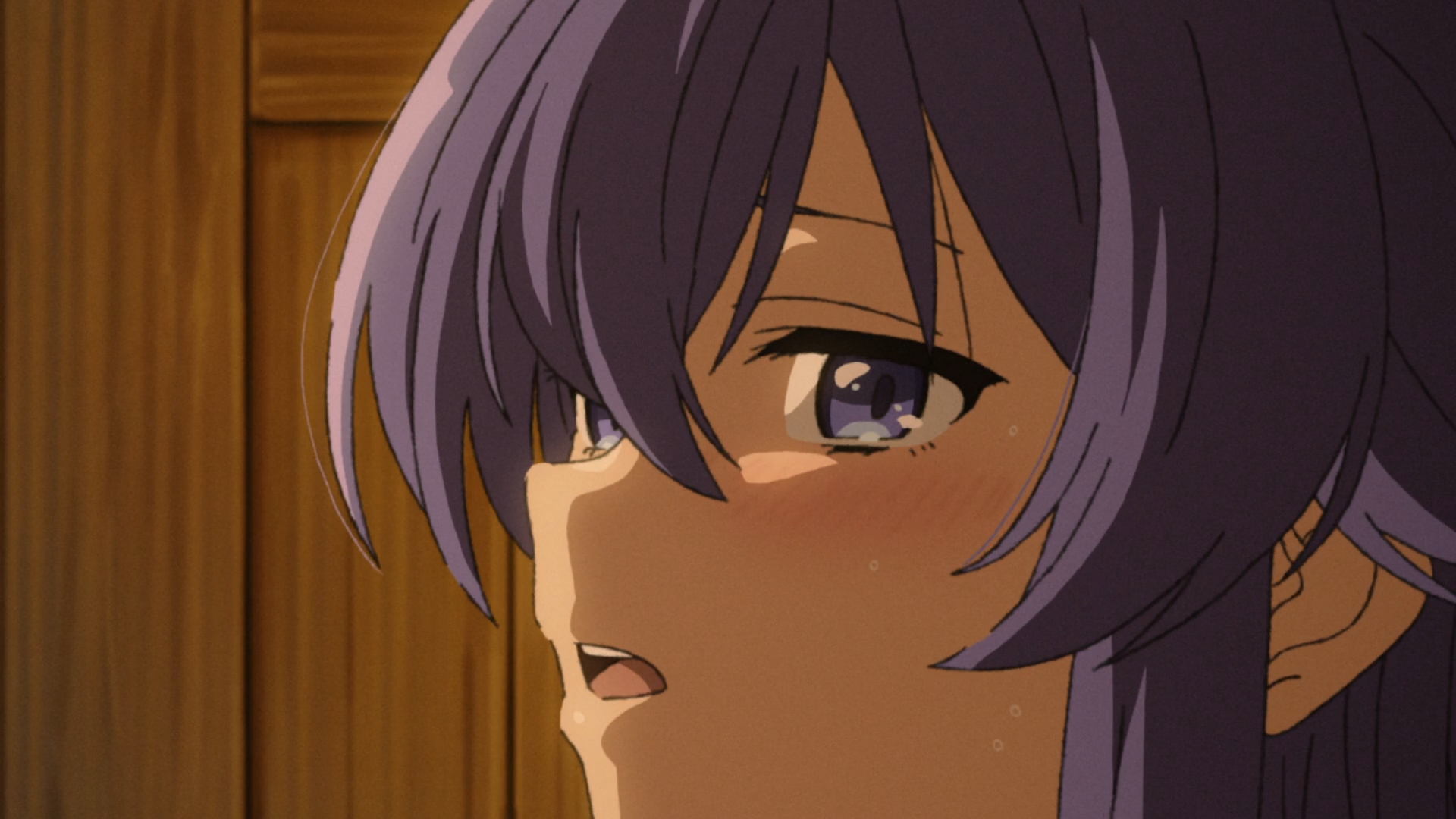
Eris Boreas Greyrat, cousin to Rudeus Greyrat and heiress to her family’s land, red hair and little body and those fiery eyes, is annoying as hell. Rudeus at one point called her the protagonist of a delinquent manga. Rudeus put it too nicely. I do not subscribe to Kazuma’s feelings on true gender whatever he says in KonoSuba, but I don’t think Rudeus should take all that crap from Eris. He should’ve but his foot up her ass.
I do not like this character. Eris personifies the kind of violent, loli tsundere character type that I (mostly 99%) detest. She always thinks she’s right, and even when she gets to a point where she can even recognize that she’s wrong she can’t admit it. “Hmph!” Stop that! I hate that! Rudeus looks at her wrong and she socks him. Rudeus probably deserves it one way or the other, but still. She deserves it too, and no one whacked her over the head for it every time she commits the slightest of faults. Which she commits plenty of.
Everything about this character is extreme. Extreme violent reactions to ordinary offenses. Extreme strength for a tiny body. Extreme emotions about everything, from the anger to joy to sadness to uncertainty. Extreme loudness. It’s all the extreme of annoying.
Speaking of extreme behavior: she acts like she’s a big woman, giving Rudeus a “reward” by sleeping with him, when she really is just hella horny for him and she won’t admit it, just like she won’t admit anything else. Rudeus feels like his affection for her is being returned and that they’ve broken through the barrier Eris puts between them. I even felt that. Then Eris gets weird and walks away, leaving Rudeus with nothing. No family, no Ruijerd, no Roxy, no Ghislaine even since Eris takes her with her. What the hell was that? Oh it was a nice piece in this story ultimately, but it doesn’t say anything good about Eris.
Protagonist of a delinquent manga. So annoying.
Does anybody like Eris? I realize people do, and I still like you all, but I know I can’t figure out who thought this character would be anything but tiresome to audiences. Is she supposed to be that way? I doubt it. I figure she’s supposed to be a likable character on some level. It’s not a level I understand. If I met someone like that in real life I’d borderline want to murder them, boy or girl, not fall in love with them. I don’t find this character the slightest bit attractive or appealing or even sympathetic. It begs the question why Rudeus likes her. Perhaps there’s something there, but it’s so overshadowed by her annoying behavior I can’t even begin to consider it.
And I love strong female characters. And not just the Ghislaine types. I don’t need appearances to go with strength. But I don’t need that tsundere self-righteousness either. That’s not strength, that’s not confidence, that’s mental immaturity and weakness (see Asuka Langley Soryu in the dictionary for further reference). That’s all I see in this character. A strong body with an energetic personality and absolutely zero mental fortitude if she doesn’t have someone near her to either fight alongside her or for her to bully. My view of her is totally negative. Please tell me I’m wrong about all this.
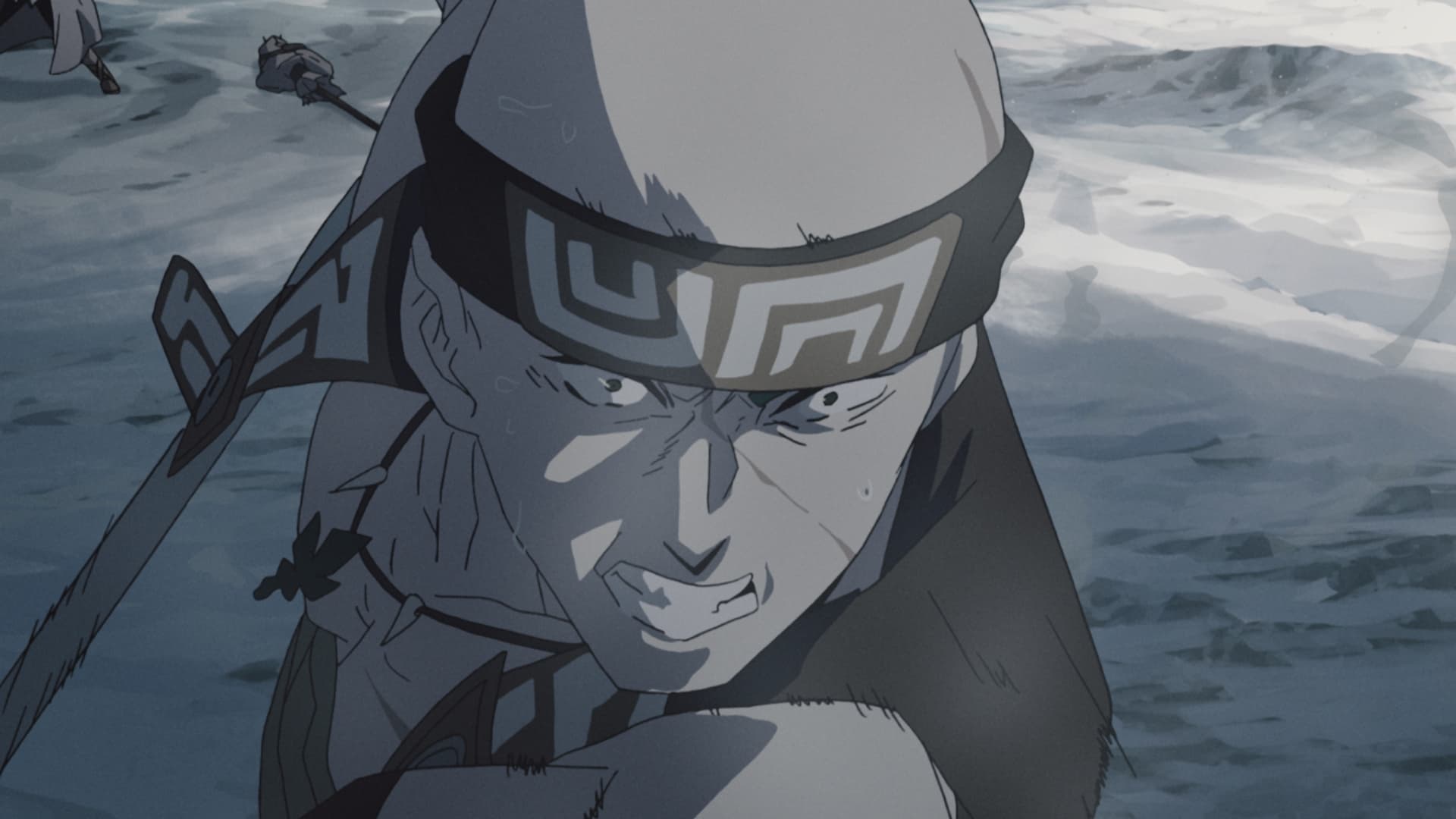
Ruijerd is a fun character. There isn’t much to him, but I will give another shoutout to Daisuke Namikawa for a nice voice performance here. Namikawa is best known for the smooth-talking Hisoka from Hunter x Hunter (another excellent performance), but I remember him best as my man Roku from Black Lagoon. The thing with Ruijerd having the terrifying Superd reputation was a little weak, but that’s more of a storyline thing than a character aspect. He works well as a character.
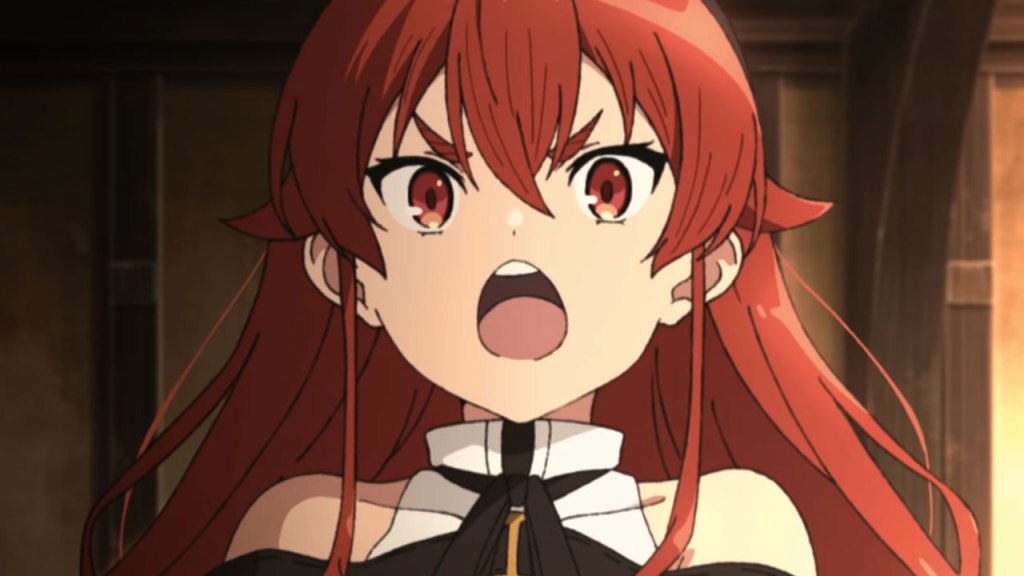
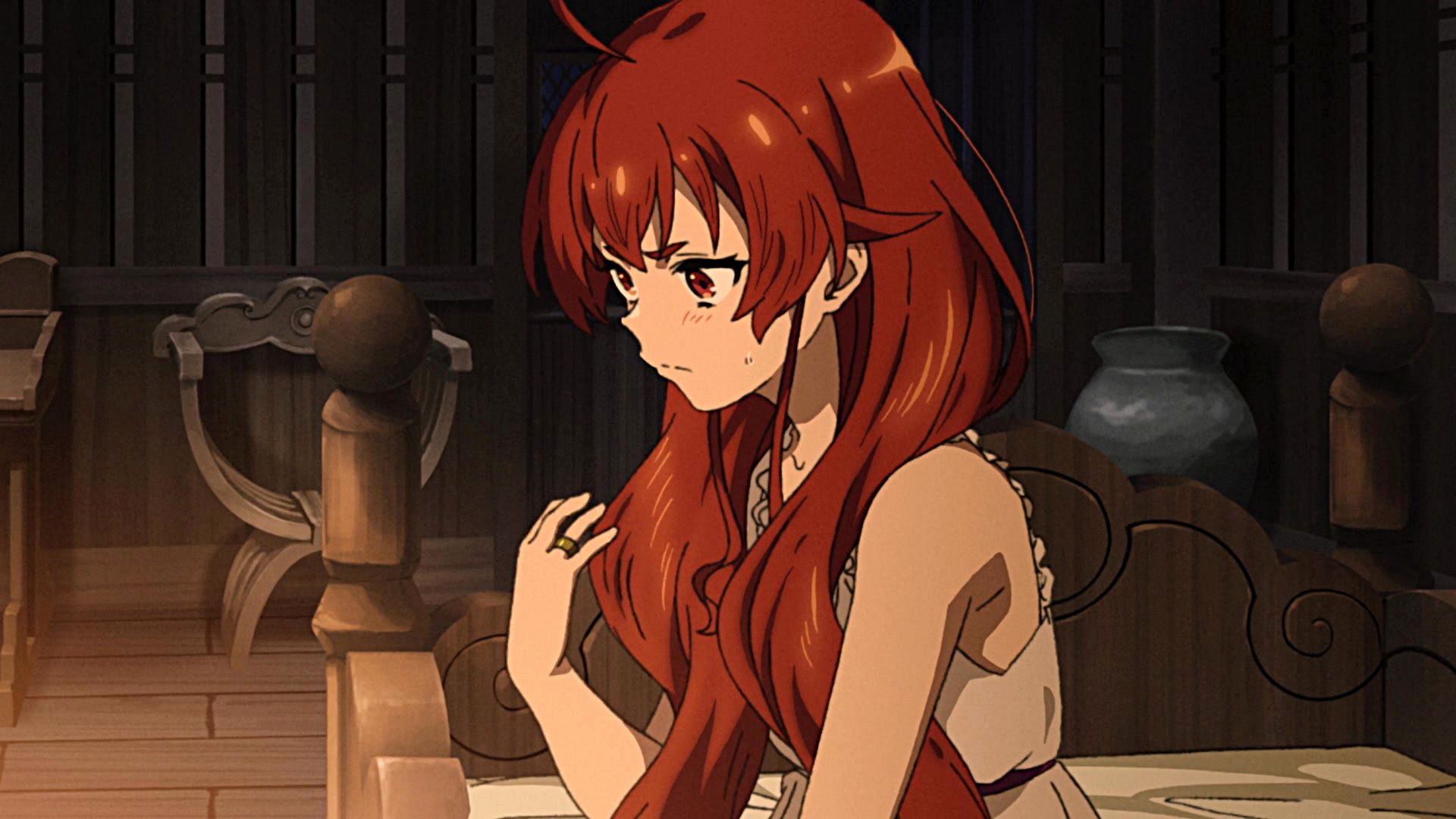
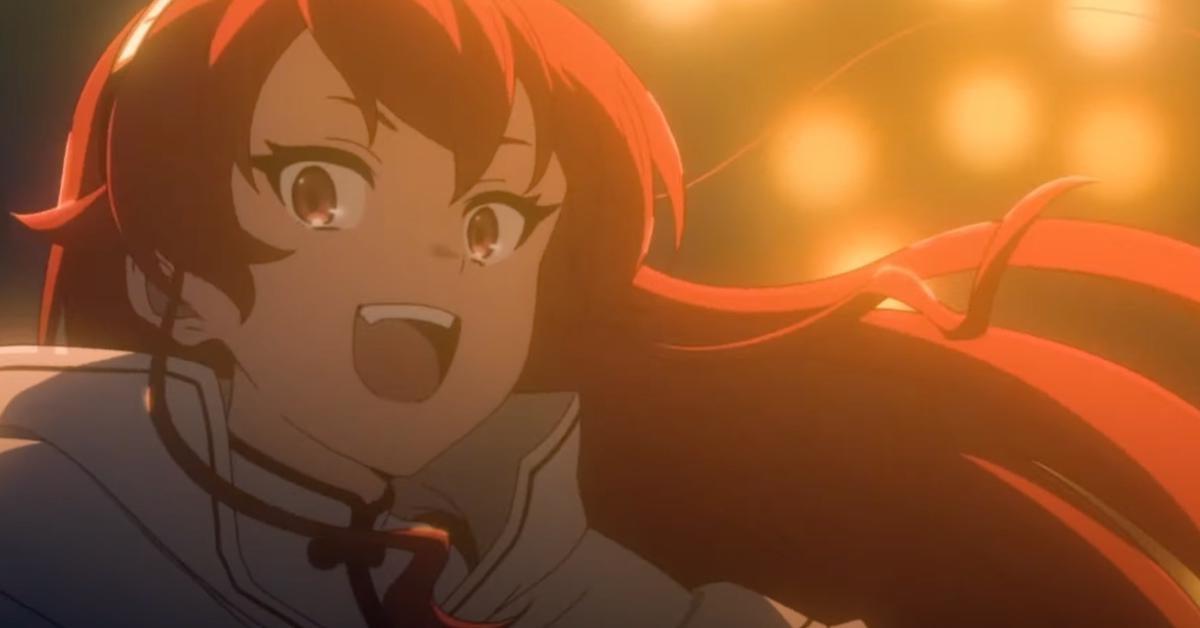
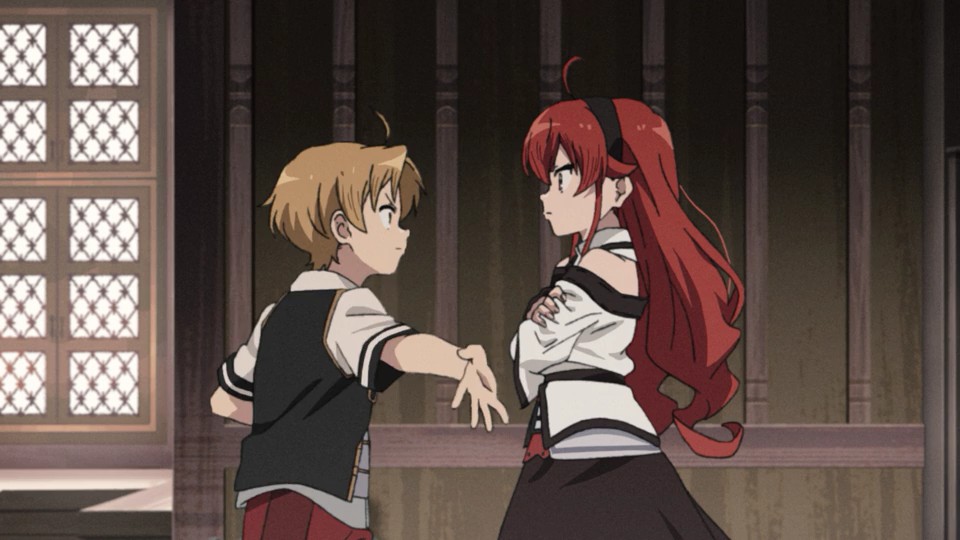
Eris has a lot of nice frames like this one, which I will readily admit despite disliking her character.
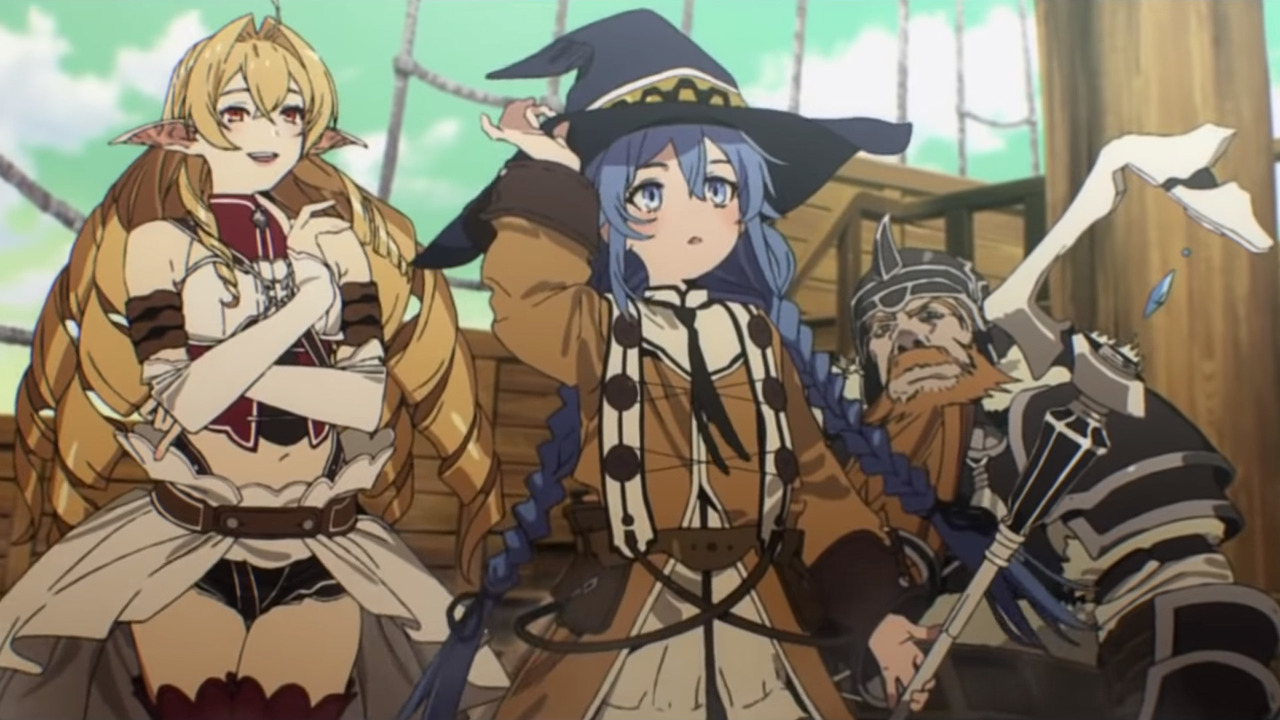
Roxy is kind of an odd character. She’s a main character until suddenly she’s gone, only reappearing briefly for a short time here and there (unless you happened to see her running around in the background one of those times). Her interactions with Rudeus was one of the first things I noticed that made me think something was off about this show. I knew this character was being voiced by the girl who played Chika Fujiwara (Kaguya-sama: Love is War), Konomi Kohara, but I had a hard time making that connection. Perhaps because those two characters are so different—who else is like Chika after all? That versatility speaks well of Kohara-san.
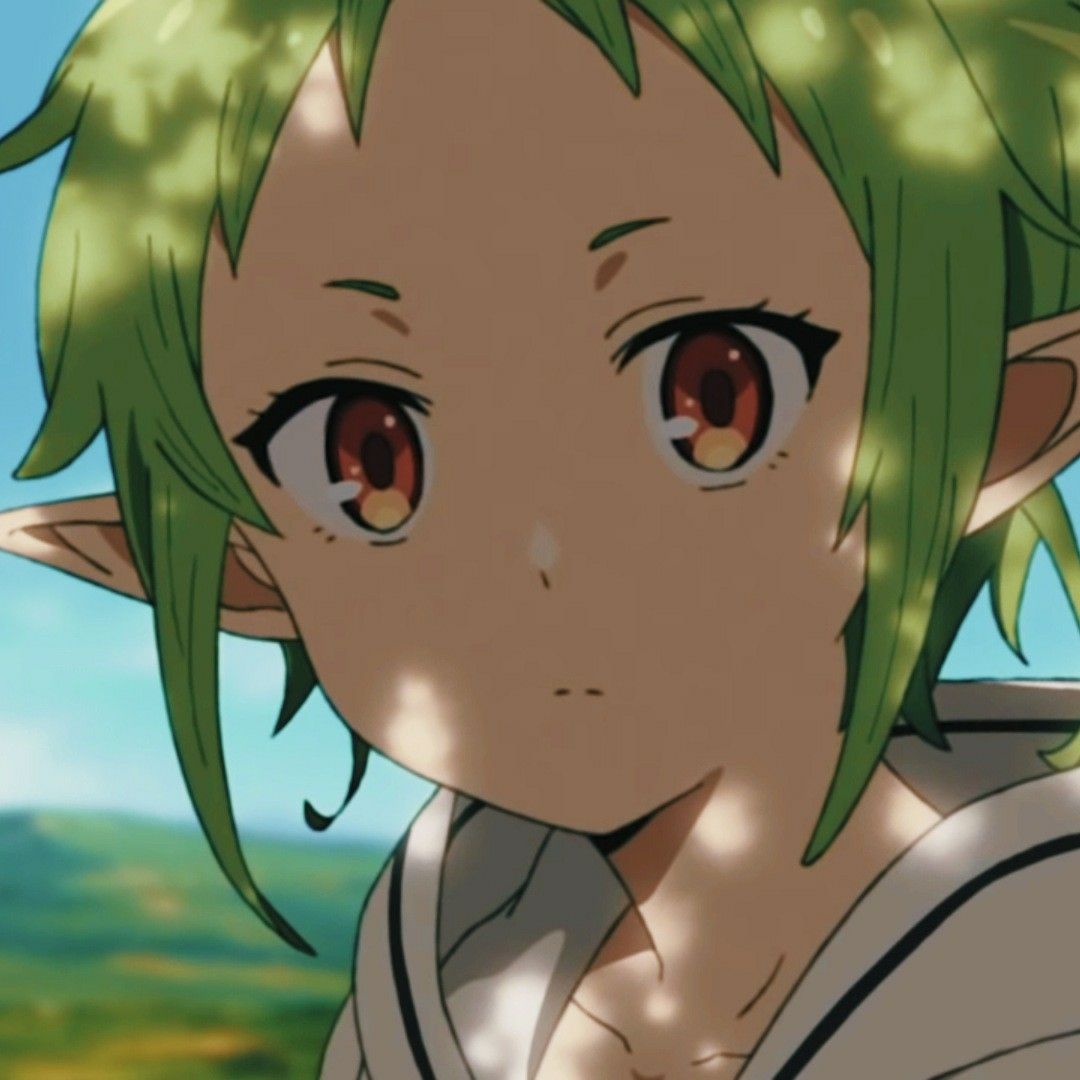
Funny thing about Slyphiette, I was mostly right in my predictions about her through the second season. After being such a true friend to Rudeus then getting snapped away in the mass teleportation in S1, she did eventually reunite with Rudeus and they eventually got their true feelings for each other across to the other, and so far they all happ livilyed ever after. More on that in the Story section. Sylphie’s a sweetie. I still wonder how all that will fall out with her and Rudeus. I imagine Eris will show up to cause trouble again at some point, and I tremble to think what form that will take, comedic or tragic. Anyway. This is another character voiced by Ai Kayano (Darkness, KonoSuba; Shiro, NGNL), so that’s makes it even easier to like Slyphiette.
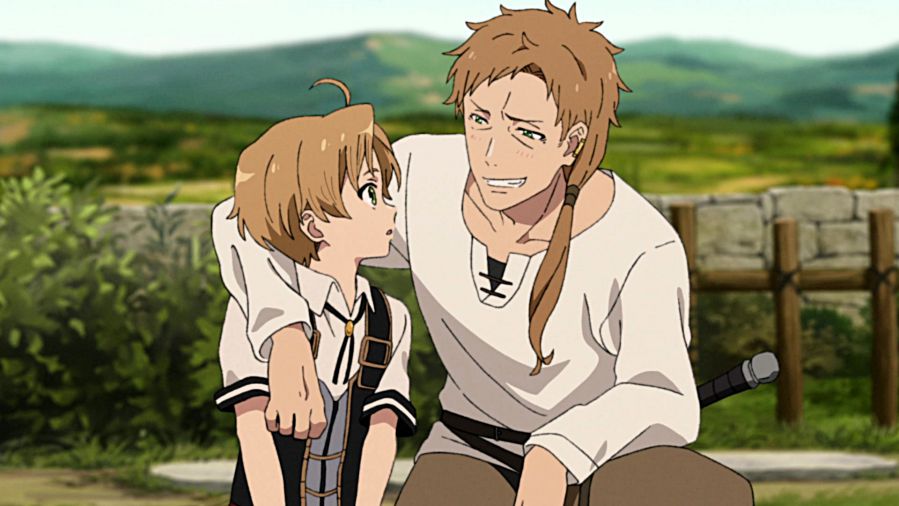
Paul Greyrat is not a very remarkable character, but I like him. True, he’s another pervert good guy type, but it works for him. He makes some bad decisions, but he definitely regrets them. He’s a soft-hearted guy for a fighter, and the writers do a good job showing that in his character. He plays his role well.
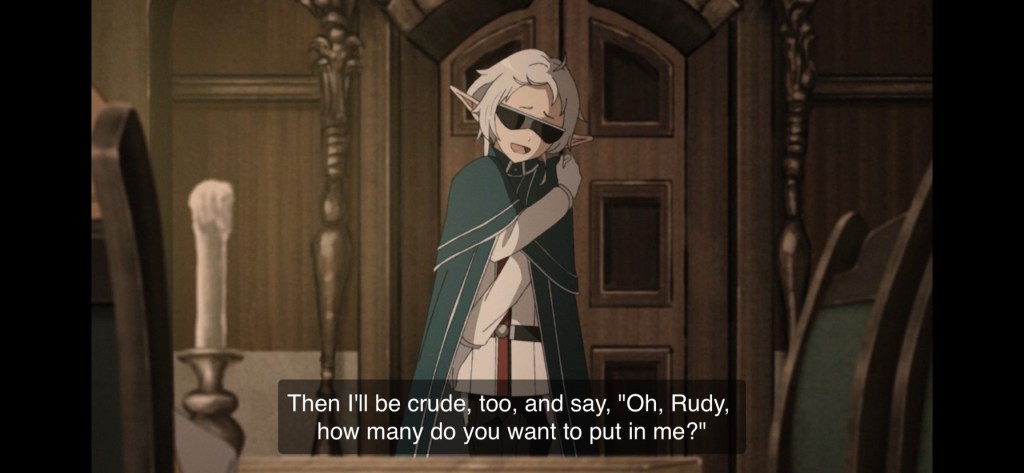
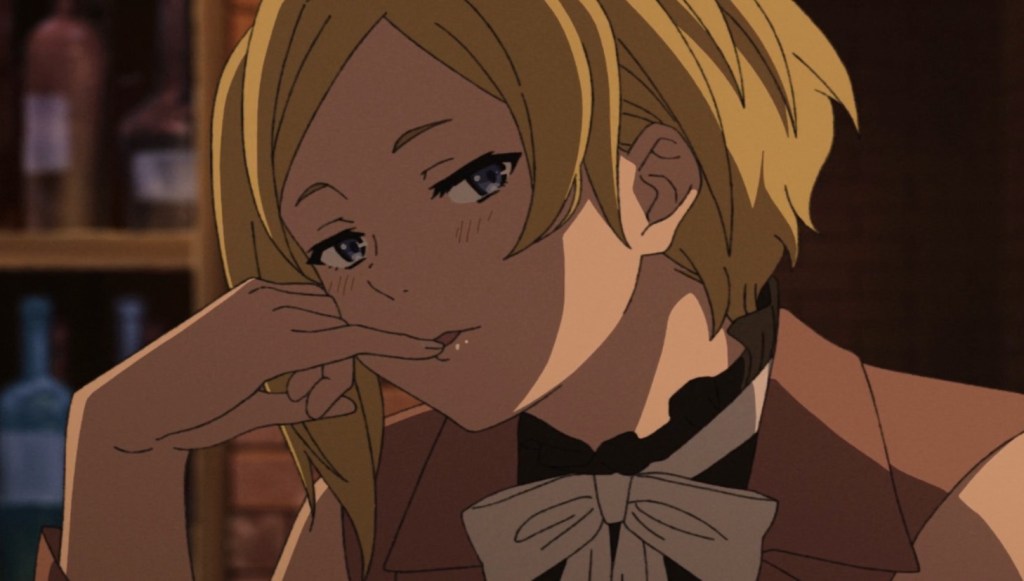
People about lost their minds over Sylphiette’s disgorging of her fantasies. It definitely wasn’t limited to this line.
Shizuka Nanahoshi. Ah what mysteries will she bring to this tale? Her tsundere tendencies coupled with the fact that she and Rudeus are both isekai victims (is “victims” the right word for this?) make me feel like she might bring more than just mystery or even resolutions to plotlines. Sylphie instantly bristled at her as a romantic rival, as Rudeus and Shizuka conversed in Japanese in her presence, rather rudely I might add, and she might be right to do so. I fear for the situation between Sylphie and Rudeus, both because of Eris and now because of Shizuka. We will see.
There are a lot of characters in this series actually. I won’t go into any more today. I will say that although I usually dislike when an anime has too many characters, this one doesn’t bother me too bad in this regard. Actually, I didn’t even think about how many characters it really had until I started writing this review. I think it’s not very obvious because the characters are nicely compartmentalized. They’re not all in the same place at the same time, and we don’t flash between locations very often. The action pretty much follows Rudeus, occasionally sidetracking to other characters briefly only. So it’s pretty easy to keep up with whichever limited set of characters is around Rudeus at the moment, whether that’s the extended Greyrat family plus Sylphiette or the beast people tribe or the pirate traders or the group at the magic academy. They’re nicely set apart as groups and limited in number within these groups, so even though the overall number of characters is very high, it never feels that way. I don’t know whether that’s an accident of the way this story is laid out or if it’s done intentionally by the writers. Congrats to them either way, and more praise if it’s intentional.
A good set of characters. We’ll see how they resolve the plotlines surrounding each. We’ve gotten some partial resolution regarding Slyphiette and Rudy’s parents through two seasons now, but we still have a major plotline with the hitogami and the dragon god and of course Eris’s potential reintroduction to the tale, not to mention the mass teleportation thing, which isn’t a character storyline of course, but it is the biggest plotline in the show. More on that later. I know to expect the unexpected now. That’s what I will look forward to with great expectation.
Artwork
Rating: 7
I’ve learned something recently: people like this underwhelming art style paired with really good animation. While this combination isn’t new, I’ve found that some of the most popular shows exhibit this combo of traits. I’m at a loss to explain it. Could it be that this combination is often paired with a certain kind of story that really appeals to audiences? I don’t know, but I know that really highly rated shows like this one, Nichijou, Ousama Ranking, to name a few, all do this. I’m still pondering why this combination is so popular.
It works well enough, but it’s very obvious to the discerning eye. My first impression of this show was that it wasn’t HD. That wasn’t true of course, and doesn’t have much to do with the artists themselves, but that’s how low-quality the images before me looked. I quickly figured out that the artwork simply wasn’t very detailed or very pretty. Well, it’s kind of detailed, but it’s also not. Take Rudeus’s Demon Eye or whatever it’s called. You can only kind of tell it’s different, and you have to look closely to see it.
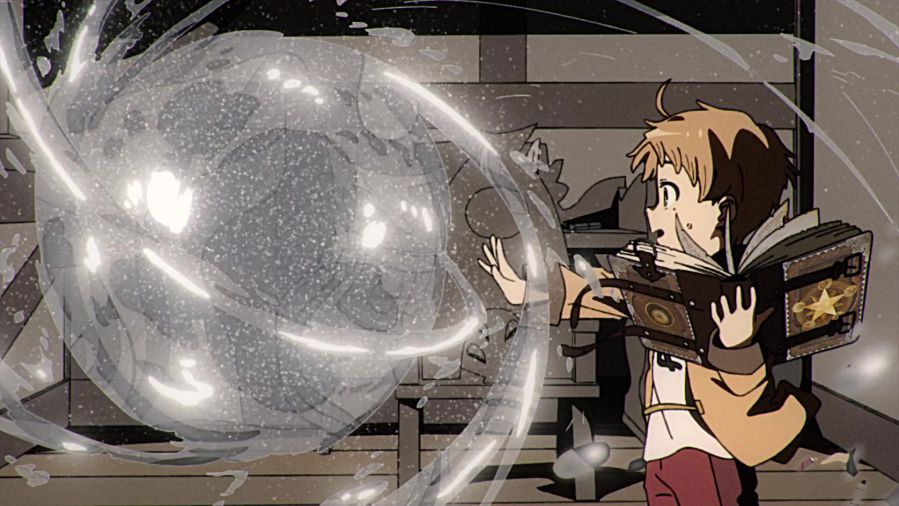
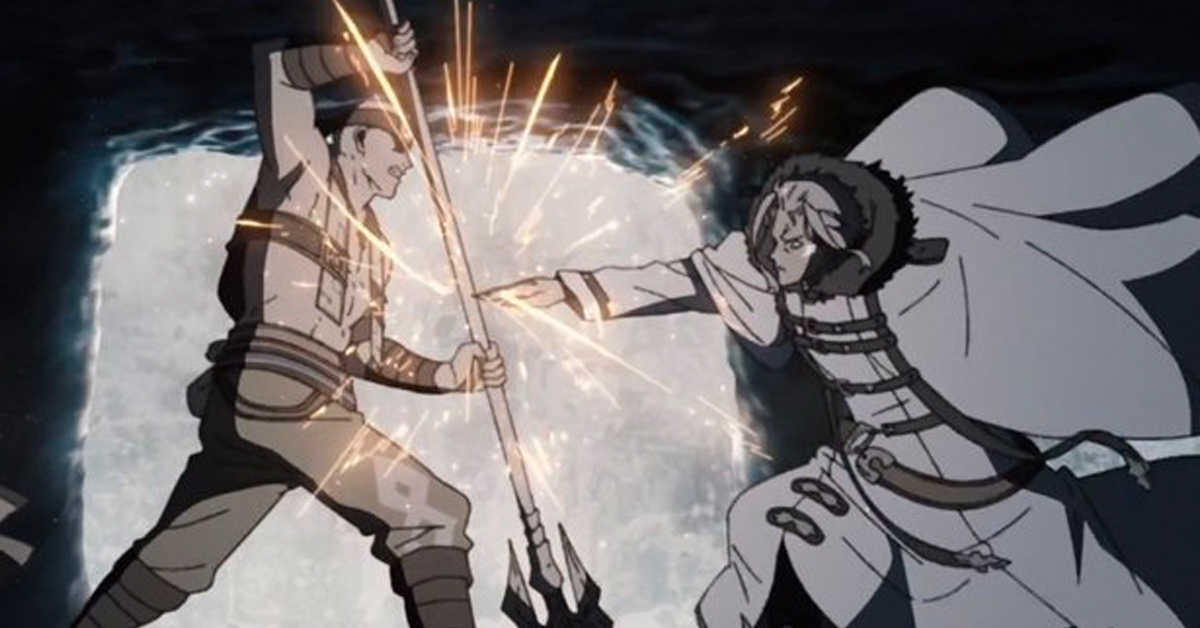
While observing all this about the quality of the drawing when I started watching, I also quickly realized that the animation itself in action sequences or anything where the action was quick or detailed was actually really well done. Good enough to redeem any overall negative feelings I have about the artwork itself. The teleportation scene is really good, as are the fighting sequences. There weren’t many wow moments, but the animation clearly got the largest portion of focus from the artwork team.
A good example of the issues I have with the artwork in this anime. Note Rudeus’s appearance versus the graphics for the spell.
Why not have both high quality drawing and animation? Why limit the quality of the drawing? I’m not sure why. I noticed it pretty quickly and pretty regularly throughout the show. I like the nice animation, but I don’t understand the neglect for the drawing itself. Artwork is everything in anime, on the same level of importance as animation I would argue. Make it right. I have to hold the fact that one is deficient against this show.
That being said, the animation is really, really good, as are many of the keyframes in intense moments, be that intensity from impending sex or some badass battle moment. S2 really solidified my impressions of this. Between the two seasons there are several action sequences that I remember distinctly even well after watching them. That means they were not only high quality but they had impact. Anime at its core is about animation sequences, and this show does it very well.
My only theory about this blah base artwork combined with great animation in this show’s case is simply that since frame-by-frame artwork in animation sequences is already very “low quality.” The biggest reason for this is familiar to most avid animation fans: most animation motion is based on “deceiving” the eye into seeing the artist’s desired motion, and this is more easily done with the most basic of images rather than very detailed ones. If you freezeframe an action sequence in any anime you’ll see what I’m talking about: the drawings themselves look crappy, but the sequences themselves look fine, as the drawings have just enough detail that our eyes still recognize the characters.
This was a great sequence at the beginning of S2. Again you see even static characters drawn intentionally out of focus as misty, magical waves flow past our near vision, partly because of distance (far background), partly because of the motion inherent in the frame.
Some anime choose to handle this differently and often with better success. Demon Slayer, which has some of the best action sequences in modern anime, is famous for the slow-motion effect they use in key action sequences, and of course there great detail in each frame’s drawing, regardless of the technique being used for the motion, is very necessary. But historically the trick is to use “low quality” drawings that lack detail during fast sequences. I wonder if Mushoku Tensei, for whatever reason, seeks to reduce the “quality difference” between its normal drawings and its action sequence drawings. I don’t know why they might do this, but it might explain the otherwise sometimes poor-looking artwork. Quick transitions between action and inaction? I’m not sure.
The show is not visually very pretty. It’s dull colored for one thing. The glassy appearance of the eyes feels dull even. There are a typical isekai variety of colors, but they’re very dull. Everything has a brown or sepia tint, which doesn’t appeal to me. Characters who are supposed to be pretty, like Eris, Sylphiette, the women around Paul, aren’t super attractive. Ghislaine’s face is attractive to me because of the calm strength that’s present there, and her body is top-tier, but even she doesn’t have the remarkable beauty you might expect. No girl’s appearance (or boy’s I’ll venture, though I can’t speak to this personally) makes your heart skip a beat here. I don’t expect that of every anime, but nevertheless. Although, Ghislaine has the heterochromia thing going on with her eyes, which makes my heart skip many beats. And abs. Abs too.
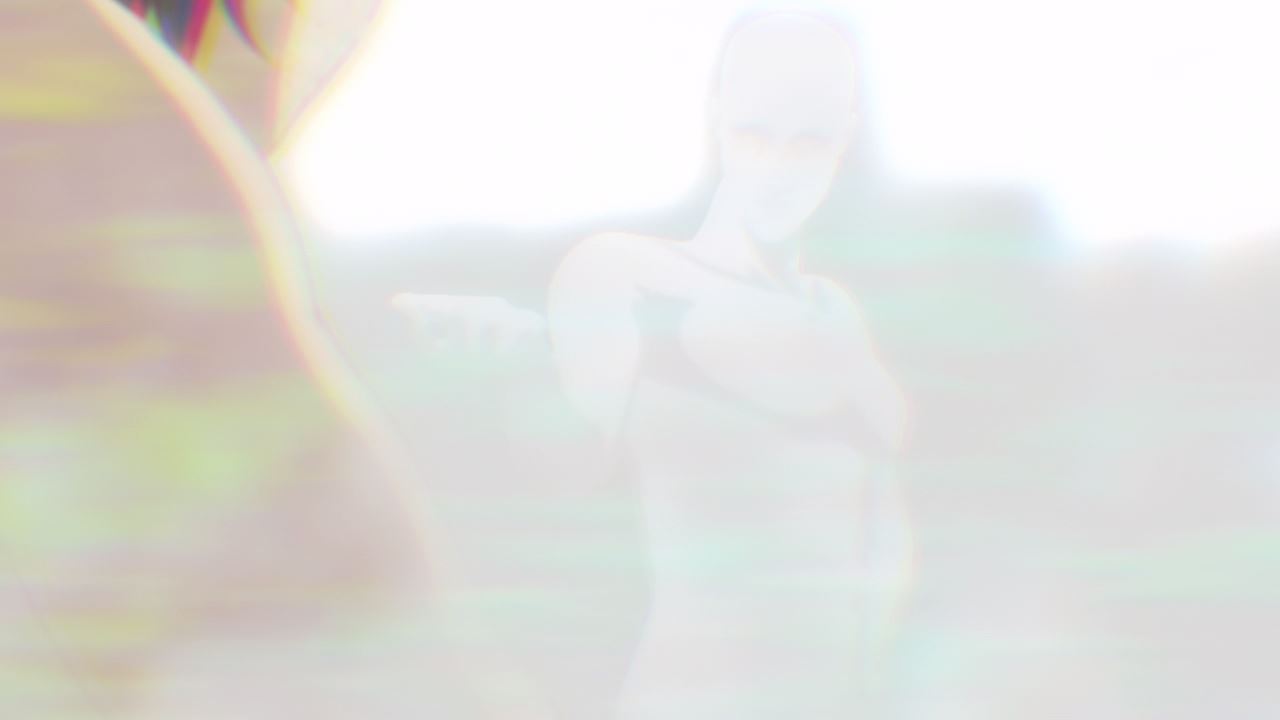
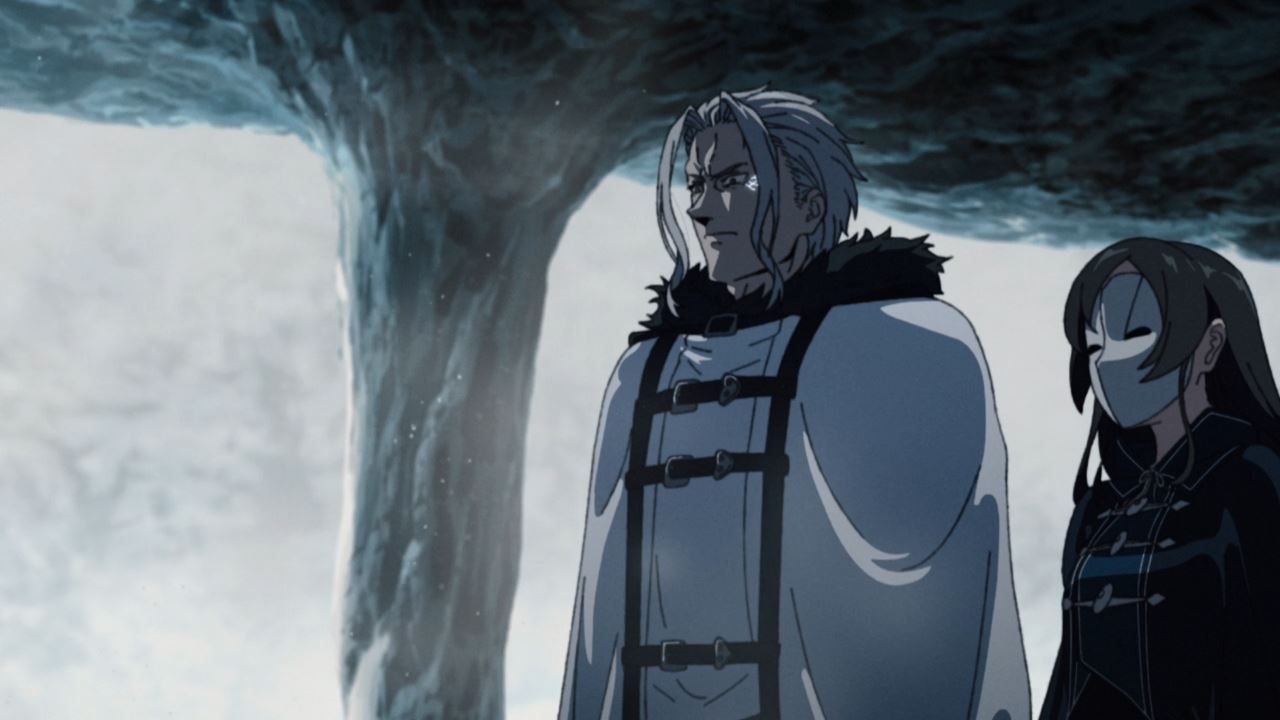
I found the hitogami animation curious. It’s clearly different than the rest of the drawings. I don’t know if it’s CGI rendering or if it’s rotoscoping or something else entirely. But it’s curious. It’s not very remarkable as an artwork aspect, but it’s a curiosity, and it attracted my attention. I wonder if it has some deeper artistic meaning.
I’m satisfied with the artwork, despite it all. Clearly the animation was the priority, and while I wish the drawings themselves were better, I can’t complain overall due to the animation quality and some of the visually stunning moment scattered throughout this anime. It’s very visually memorable, say what I will about overall drawing quality or tint or anything else.
Story
Rating: 8
Isekai varies widely between being either character-driven or story-driven or even artwork-driven. It’s all over the place. This anime is primarily story-driven despite good character design. And there’s a lot going on in this story.
First, the writers did a good job bucking the “typical isekai” label very early on in this show. While it started out with that typical feel, it didn’t last long. Something felt very off. Rudeus’s parents having sex very loudly and him listening to it in the background, while Roxy sits in the hallway outside the parents’ bedroom and gets herself off listening to them…I knew I was in for something different. It was a rather base way to signal audiences, but it left us all with a clear understanding that this wasn’t a normal isekai. Same thing when Roxy almost killed the horse with an errant lighting strike. Things were going wrong or weirdly here where a normal isekai would either never include such things or be squarely in the KonoSuba zany comedy camp. This was clearly neither.
Another interesting thing about this anime’s story is how much backstory there is. You generally see this associated with mystery or suspense shows, not isekai. Some of it we see, some of it remains hidden (even through two seasons). The best example of the more visible kind of backstory is Roxy’s character development. She’s wandering around as a decently powerful mage, and she’s from a fairly rarely seen race of people. It’s not only unclear what her situation is, but the writers make it somewhat obvious that she has a relevant backstory. Then later we see her in her village and hear the sad tale of her inability to communicate telepathically. It doesn’t impact the story a lot, but it does impact the character. And the viewer.
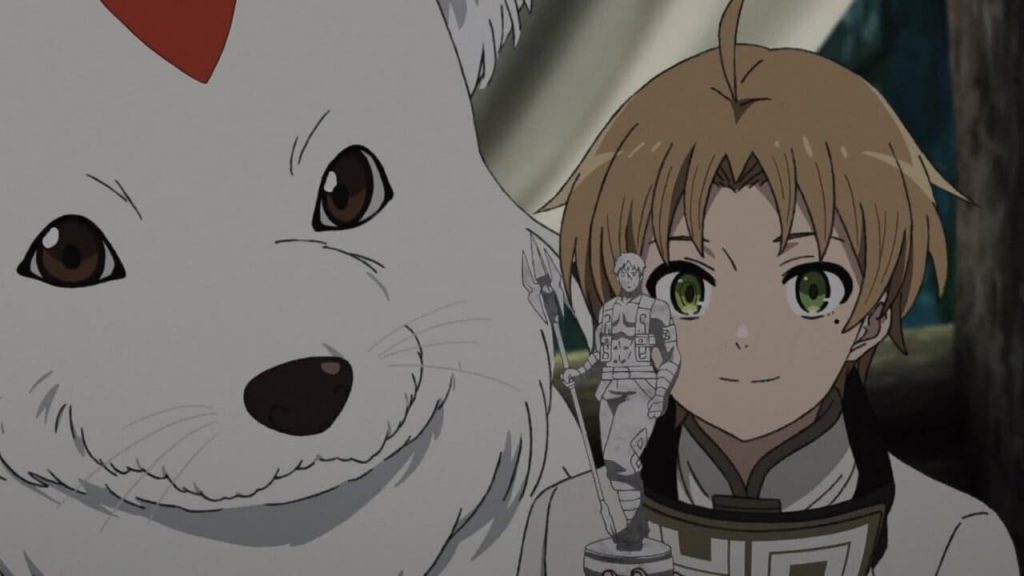
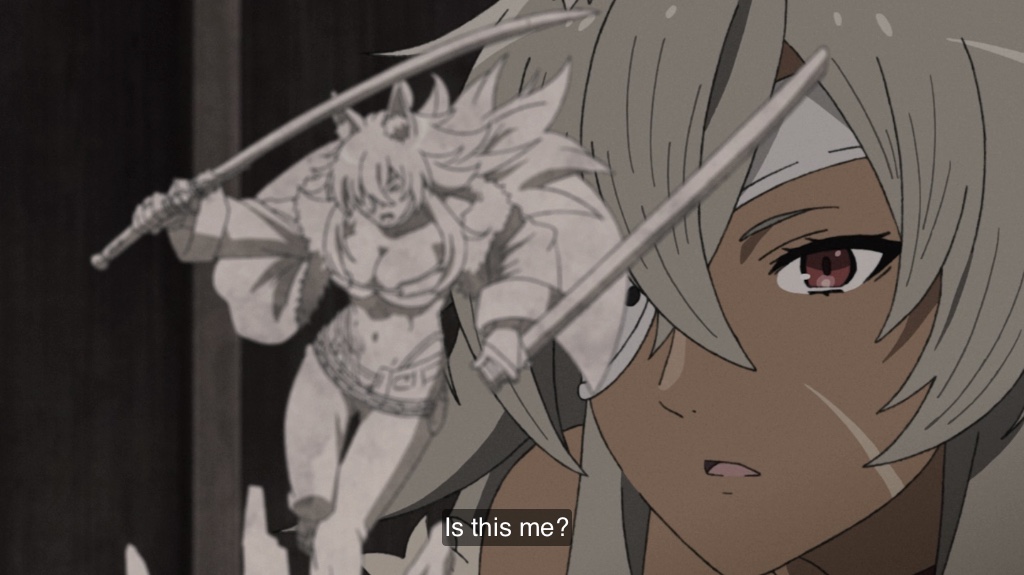
I love the look on her face pretty much all the time.The figurines thing is easy to overlook in this story–I mostly have–but it never goes away either. In fact, it continues to expand into other characters storylines. I begin to wonder if it has more significance than I ever thought it might.
Two examples of backstory that isn’t explained are the teleportation phenomenon and the hitogami. The teleportation anomaly comes out of nowhere. No explanation is even hinted at through one season, and the second season only advances that mystery slightly. No sinister, typical bad guy or girl has been seen from the shadows getting reports from underlings. We know little about what this is or why it happened despite the hypotheses thrown at us in S2 (manga readers shizukani). We only know that it’s perhaps the biggest defining feature of this story. It’s at the center of everything, but we still have almost no explanation for it. Talk about backstory being apparent but incomprehensible.
The other example is the man-god, the hitogami. Who is he and what is his role? Isekai often has featured beings like this who inhabit an in-between world and play various roles. But this one is rather enigmatic. The animation choices mentioned above are a visual cue that something is really peculiar about this character. But other than that, we know nothing about him.
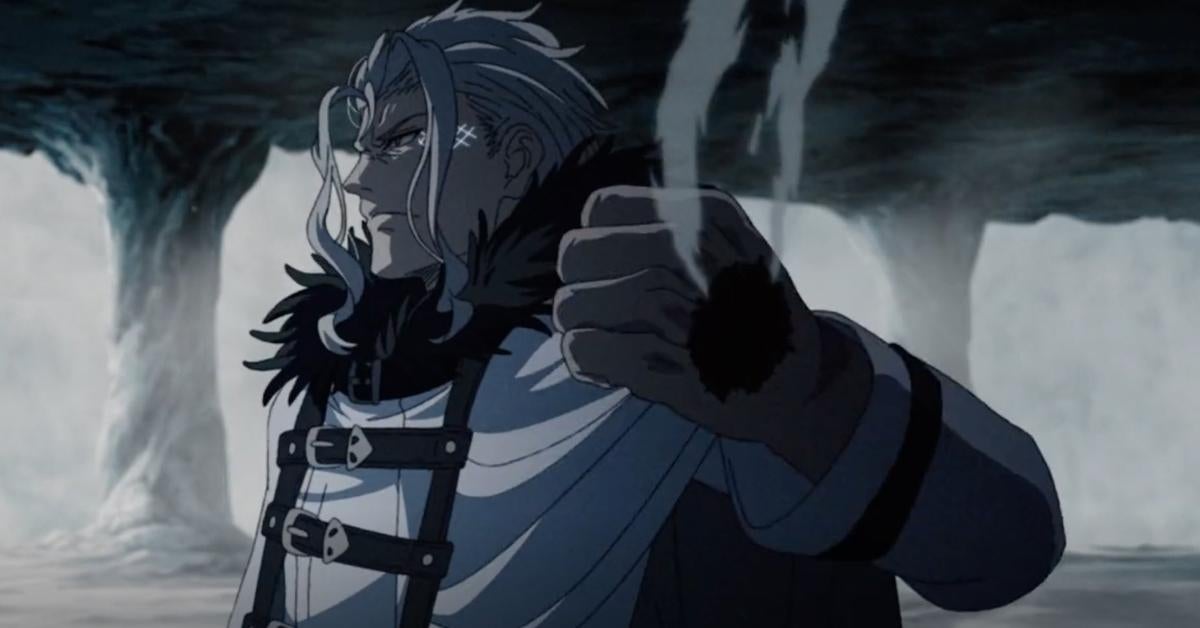
Connected to this is the strange encounter with the overwhelmingly powerful Orsted, the dragon-god. I loved this episode. It’s not easy to pull off an effective storyline and character type such as Orsted. This show has a couple of character-role types that I really like, one of which is used for Orsted. An immensely powerful, legendary being encounters our rather ordinary-by-comparison group of protagonists in the ordinary course of their lives. It has all the tension and fear-factor you could hope for from such an encounter in a story. That aside, what’s with his animosity towards the man-god? He doesn’t seem overtly hostile to the race of humans until he hears the man-god mentioned, whereupon he attacks Rudeus’s party and crushes them in his power. Then of course he heals them all and goes on his merry way (partly due to his traveling buddy’s insistence, which we learn more about in S2). And why is Rudeus the only one not affected by him? Ruijerd and Eris are rendered helpless with the fear Orsted casts passively on people around him. It’s a remarkable encounter.
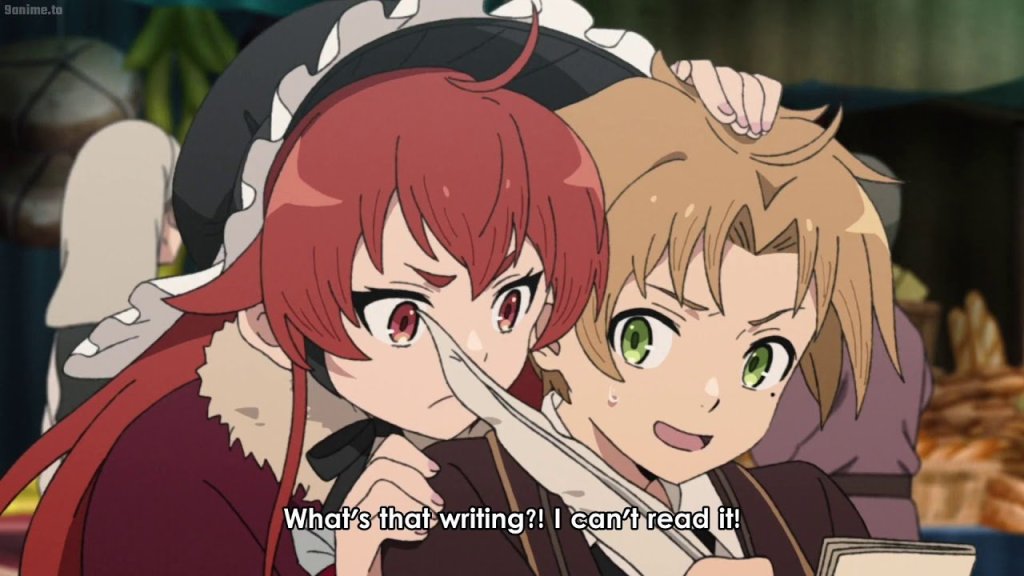
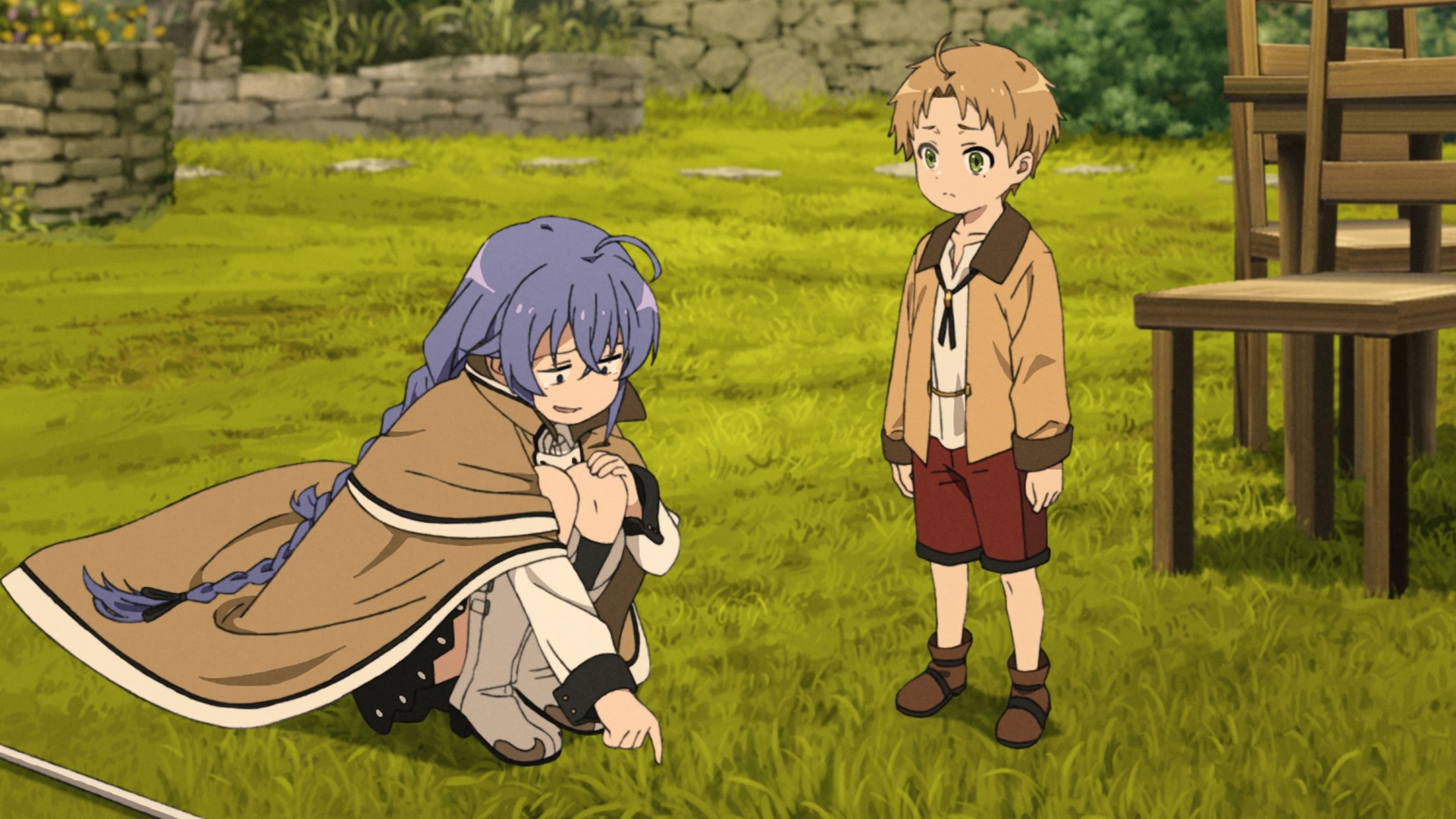
Quoth Rudeus: “Of course you can’t Eris. Not only did you not want to learn to read, you refused to learn to read. Violently.”
The story is a little random in the first half of S1, following Rudeus between his relationship with his father and his friendship with Sylphiette and his family drama and the introduction of Eris, etc. Then the teleportation incident occurs and the show becomes mini-arc-based. Rudeus encounters Ruijerd and adds him to his group, they encounter Ghislaine’s people, they fight the smugglers, and so on. These encounters last two or three episodes and then transition right into the next mini arc. It changed the feeling of the show pretty significantly, from an atypical and curious isekai to suddenly much more recognizably isekai, where a party of adventurers wander between adventures, with guilds and powers and other guilds and other guild members and strange allies and enemies abounding. It was an odd transition.
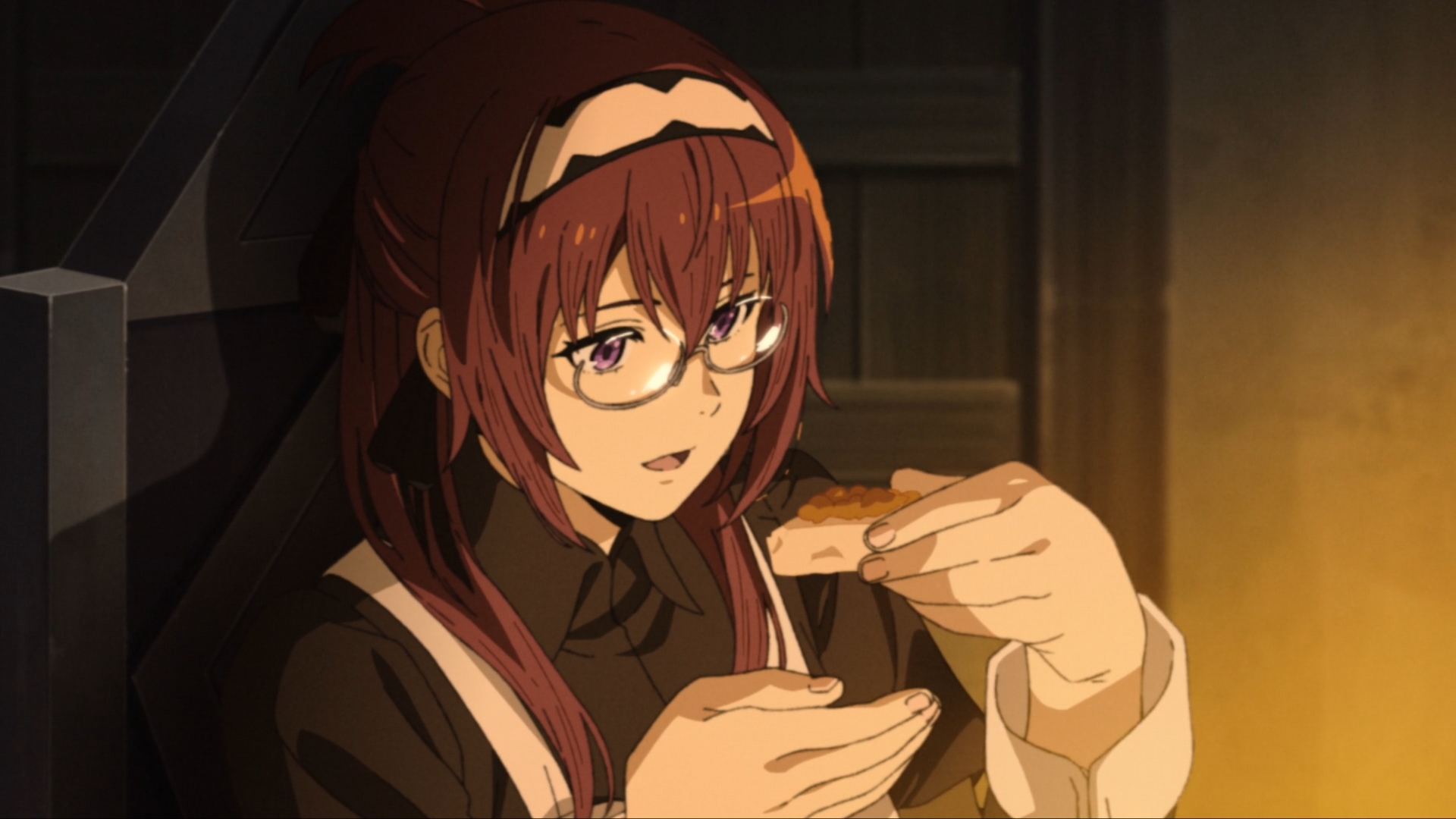
In the middle of all this transition to a more typical, more familiar kind of isekai format, Rudeus encounters his father and his group that’s been searching for survivors from the teleportation incident. It’s one of the sadder mini arcs, as we learn that Rudeus’ mother and the maid (ahem) are still missing, and it clearly is wearing on Paul Greyrat. He’s very much a changed man, almost a broken man. When he hears what Rudeus has been doing, what we’ve all been watching Rudeus do, he makes a very relevant observation: you’ve been out there playing while we’re all here worried and searching for those we’ve lost.
While it’s neither here nor there whether Rudeus’s adventures constitute playing or not, that’s not the point. I find it curious that Paul observes the thing we recognize as typical isekai behavior and angrily decries it. It’s coincidental to the story of course: his reaction is based on Rudeus’s excited retelling of his adventures making it seem like Rudeus has been out having fun while everyone else is panicked trying to find their families. But for the viewer, it highlights that this typical isekai behavior is unusual; Paul finds it distasteful in face of the real troubles they face. Maybe there’s not much to this, but it’s curious when a character notes a change like this within a show, a change that we see from the outside in a slightly different manner.
Sara was a little like Eris. The only difference is Eris defended herself in her insecurities, in every sense, whereas Sara put herself out there, and she got burned for it. My dear people, don’t try to fall in love with someone who reminds you of someone else. You don’t want to go where Rudeus went when he did exactly that.
Then in S2 there’s this little matter of a little guy who can’t. I said I’d get into it, and you all waited patiently, so here goes.
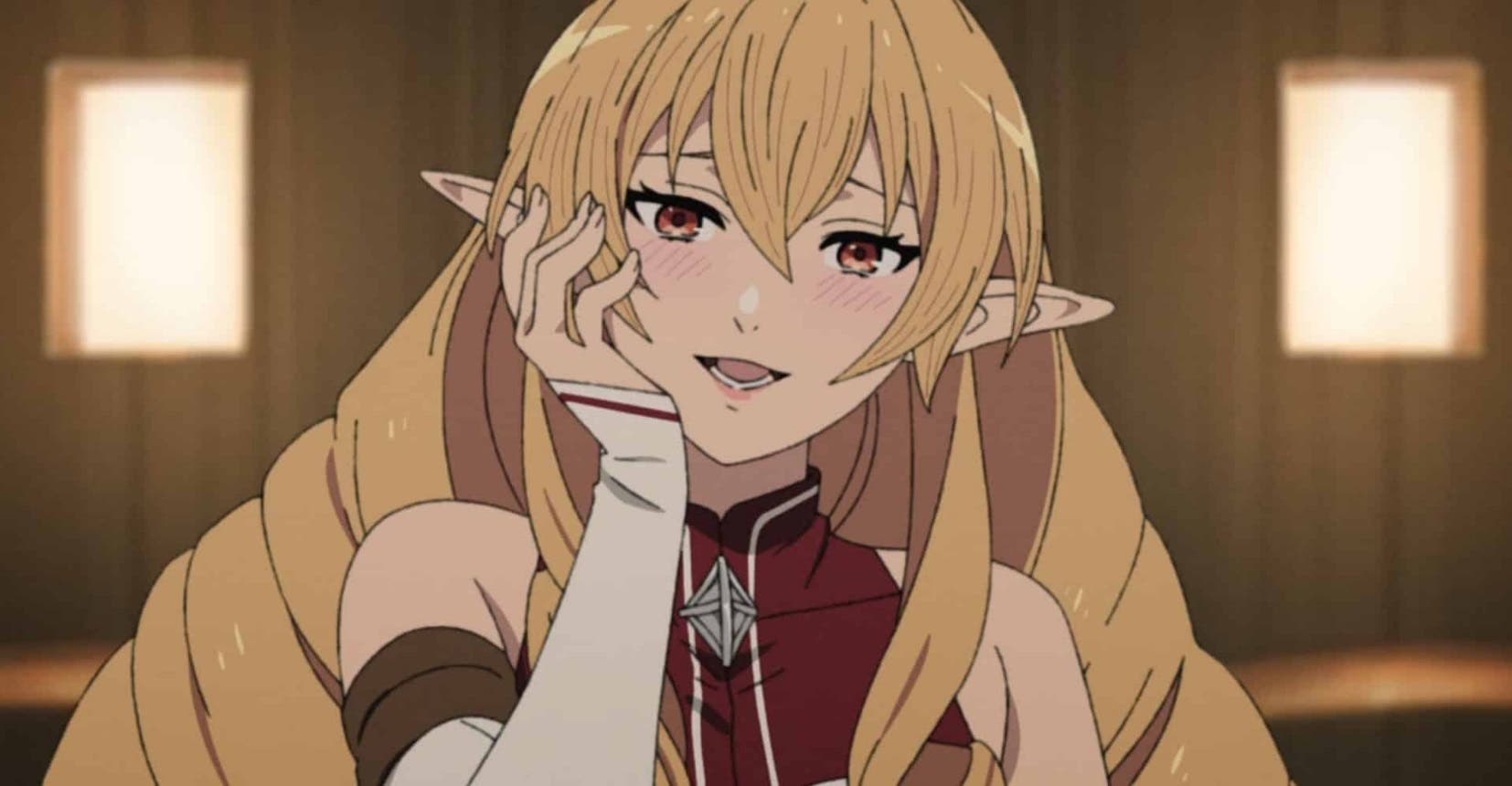
I have mixed feelings about this aspect of the story. The negatives are pretty obvious: it shifts this story heavily towards its already strong proclivity to dive deep into sexuality, making this story very centered around sex in general. It definitely did that. Even discussing it feels a little like philosophizing about dirt. It’s a little crass, a little base, in other words. Such things lack worth. It also occasioned the reintroduction of Elinalise into the story in S2, a wild sexual reprobate of an elf, and we got every ounce of that dosed out to us poor viewers during S2. Not to mention the disgusting enshrinement of Eris’s panties (wait, were they Roxy’s? My mind can’t store that kind of data for long). That was one of those things people just kinda decided not to talk about in S2 of this series, but it was definitely there. As the man said, “It is pronounced ‘e-gre-gi-ous.'” It also occasioned three lead-up-to-sex scenes, if not the actual sex scenes themselves (consistent with S1 and Eris and all that). So that’s the egregious side of this character aspect that’s obviously a bit of an issue.
But outside of the Elinalise thing (which actually concluded in a really funny and wholesome way) an argument can be made that this was a great choice by the author in regards to Rudeus. The way the situation with Eris ended was pretty sad, but it wasn’t terrible by itself. What was hella sad was that this ED issue was the fallout of it. Two things arose from this that caught my attention. The first was that this character element made huge emotional waves in this story, and particularly in the way male audiences would understand, and which brought about an important conclusion to a S1 storyline that also ended somewhat sadly previously. Second, this got me thinking about the strange situation between the subconscious and the physical Rudeus. I’ll get into both briefly.
It was at this moment he knew. Everything went downhill from there for a while.
You rarely see male audiences targeted for emotional impact in anime in this way. Yet I bet there wasn’t a male viewer of this anime who didn’t feel sad at he conclusion of the episode where things ended poorly between Sara and Rudeus. Long story short, S2 begins with Rudeus feeling dead to the world over the Eris matter from the end of S1, and he falls in with a fun troupe of adventurers, one of whom is a very tsundere Sara, who likely reminds him of Eris. They fall in love and try to do the deed, but Rudeus cannot, learning for the first time he has what he assumes is ED. After that ends uncomfortably between them, Rudeus meets a buddy from another troupe in the streets and loudly mouths off about the situation that just went down, saying things incautiously about himself and Sara that he didn’t mean in the wild heat of the moment. Sara of course walks nearby and hears all of it, and Rudeus, horrified, sees her too late.
This was a devastatingly sad episode, but probably way more so for guys. I can imagine most guys can imagine the emptiness of disappointing a partner in the bedroom like Rudeus did Sara. It seems like a small thing, and it is in the scheme of things, but it would be oppressively shameful in the moment. I would also imagine that guys therefore kind of understood Rudeus’s unusual but loud and brash outburst, as if he were brushing the matter off, to another guy friend after the incident. And I can imagine that most guys watching this show, of any age, felt the utter devastation of seeing the pained expression of betrayal on poor Sara’s face when she heard all that. I know I felt it. Rudeus was a fool and we all know it, but guys probably sympathized with all of this, perhaps even in an uncomfortable way, as if it was too uncomfortably familiar. From a writing standpoint, targeting one’s audience like this and evoking this strong of a response, and this unusual a response, from them is very well done. It was both unusual and effective. That episode was tough.
Fortunately at that low point Sylphiette fell back into the story.
But the commiseration did not continue to emphasize the misery part. We were reintroduced to Slyphiette at the beginning of S2 briefly, then she reappeared when Rudeus entered the academy after the thing with Sara ended. The story enlarged in other areas here effectively, but Rudeus’s ED issue resolved itself. And it was through Sylphiette. Let me tell you, the whole miserable dude-can’t-get-it-up thing puffed out of existence in an instant when Rudeus got together with Sylphie and they did their thing and then Rudeus declared that he would…well, I’ll not spoil that regardless of whether you’ve seen it or not, it’s too sweet. Needless to say, the whole ED thing led to an unexpectedly heartfelt conclusion of one of the sadder partings brought about by the mass teleportation. I have learned to expect the unexpected with Mushoku Tensei, and I like that.
The other thing the ED thing did was make me consider the interaction between Earth guy Rudeus and physical, isekai Rudeus. The weirdest part about the ED situation to me was that this was happening to a very young guy in Rudeus. I guess such a thing can happen, but predominantly this is a problem for middle-aged men. Apart from the curious audience demographic thing which this brought into play (which I won’t get into here as it will take too much time, despite the glaring question here of who this anime is actually targeted at), the first thing I though of was that this effect was caused by the older, subconscious Rudeus in his head and not by the youthful body of isekai Rudeus.
Elinalise and Cliff did a thing. I imagine most people reacted like Rudeus, or maybe like Rinia in the background. Rudeus’s little wave is priceless.
Whether this matters or if it actually means anything is merely an academic question. Perhaps the author is trying to draw some thread between the weird kind of immortality presented through isekai and sexuality. Perhaps the author was trying to say that isekai, long considered a shounen genre, actually can be enjoyed by other, perhaps older, age groups; this is believably possible in my opinion, given how often the author of this work seems to try to turn this isekai work into anything but a typical isekai story, and it would partly address the target audience demographic question alluded to above. Perhaps the author was trying to point to Eris as Rudeus’s true and only love, as the inner Rudeus, so deeply in love, exerts so much control over the whole person to the point that the physical Rudeus can’t act on what he imagines are feelings of romance. Or maybe the author is a horni boi and we leave it at that. I stray.
Many theories could be formed. But I’m less interested in the theories themselves right now than I simply am in the fact that this show prompts me to comb over them in my head. It’s not every anime, much less isekai, that prompts the viewer to dive into the depths of a story like this. So this might all be a merely academic question, but not many anime give rise to academic questions.
Obviously this story is nowhere near complete, so I can hardly judge the main storylines overall. But I will say there’s plenty of intrigue and the puzzle seems to be assembling nicely. We’ll see how complex or profound the final picture is. There are lots of missing pieces still. It’s entertaining to watch it unfold, and I hope it will be even more entertaining to see how many of the threads resolve.
Overall: 8
I loved how the opening in S1 just played as we watch little unremarkable developments unfold in the images underneath that set up the episode. The show didn’t have an opening sequence, just a song that played over the aforementioned handful of scenes that were different each episode. Lots of knowledgeable fans noticed this. The music itself was unremarkable, but this lack of a specific sequence to go with the song is another unique factor that seems to mark this isekai as atypical. Then suddenly they added a specific sequence in S2. I began to question the significance of S1’s anomaly in this regard. If there’s something there I haven’t seen it yet, and definitely haven’t spent a lot of time thinking about it. It is what it is.
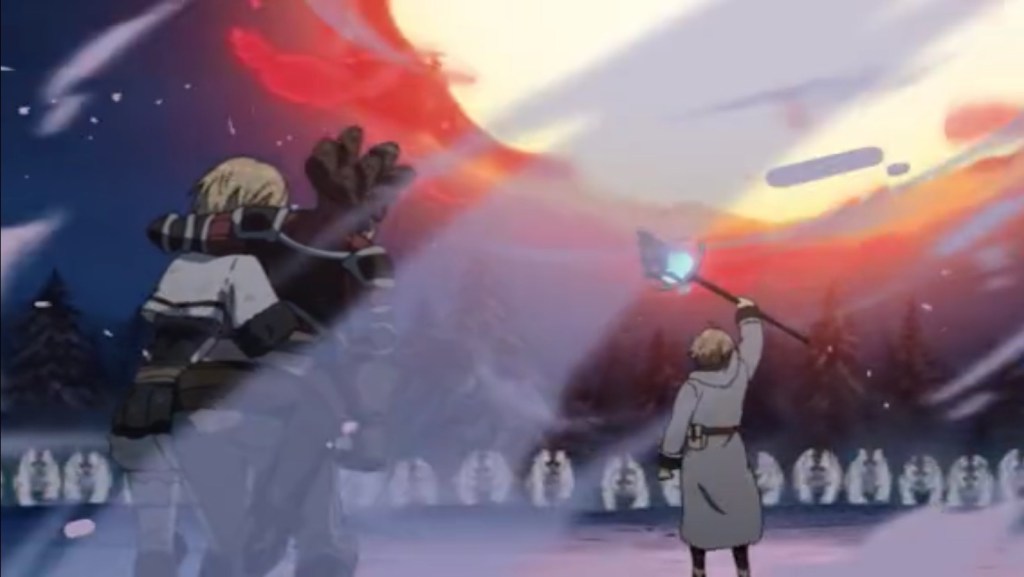
A great anime will almost always have one or two really good episodes, episodes that you remember for a long time after seeing the anime. Episode 8 of S1 did that for me here. It ended with the teleportation incident, but rapidly increased its pace throughout, culminating in that point. The mana begins to gather in the sky, and we get glimpses into several different characters’ lives as they observe the phenomenon starting from afar. In one of these scenes we’re introduced to Orsted, though not by name, and a magnificent sequences follows. Orsted is walking in a deserted land where dragons swirl overhead. One of these sees him and descends upon him, blasting him with a burst of fire such as I hope no one ever has to see. Orsted emerges unharmed. The surprised dragon, still in attack rage beast mode, swoops out of the picture for a second and then reappears right in Orsted’s face. It roars wildly and stares Orsted down. He, in turn, never bats an eye. It’s an intense and magnificent display.
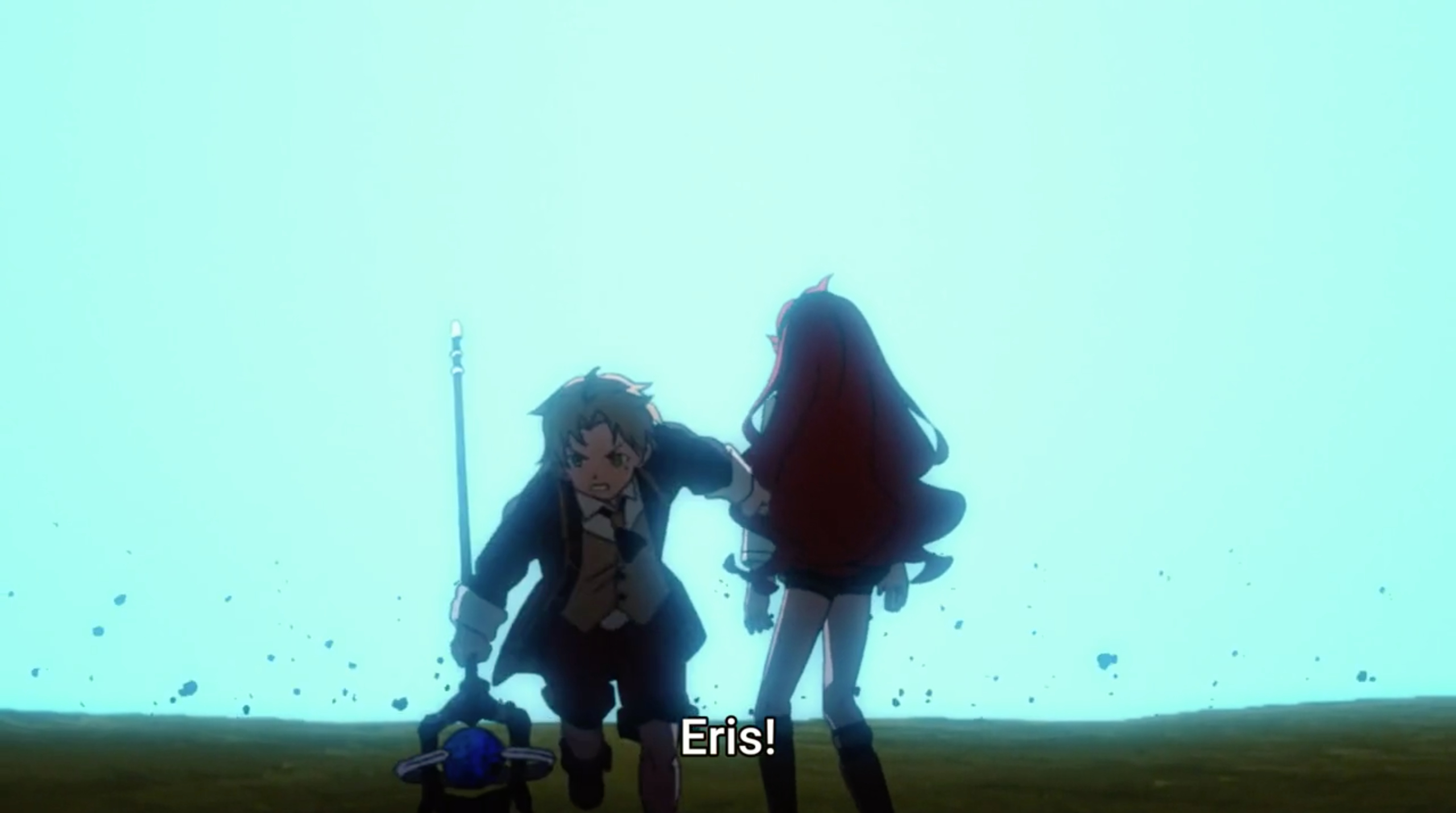
Elsewhere during these glimpses, the hero Perugius, who we don’t know yet but are essentially told is on the good side (in opposition to the fabled demon-god Laplace) sends his right-hand man, Sylvaril, down to the surface from his airborne home, who then proceeds to attack Rudeus while he is out with Eris and Ghislaine. Ghislaine ably defends Rudeus, much to Syvaril’s surprise. They manage to mostly come to an agreement, and almost immediately the teleportation phenomenon revs up. Sylvaril vanishes in a flash just as he came, and it’s upon them. A huge blue beam strikes the earth and rapidly expands. Ghislaine sees it too late and fails to reach Rudeus and Eris in time, instead getting caught in it herself. Rudeus attempts to flee, but turns back to attempt to shield Eris with his body. He clasps her tightly and the wave crashes over them, and the episode ends. It’s tremendous, a glorious 10 minutes of anime.
A tremendous moment.
If anything ever puts this anime into the stratosphere of the world of anime, it will be amazing episodes like that one. If I had my doubts about the direction of this anime, everything changed right there. That was a brilliant way to tie together lots of unrelated plot threads and establish a huge moment, a defining plot thread, for the rest of the season. And through two seasons now we continue to get pivotal episodes like this that are extremely memorable.
I’m not totally sure how I feel about this average drawing paired with high quality animation thing. Shows can be very extreme in this regard. If any of you have seen Ousama Ranking, you get a maximum dose of there. That show gives me a very negative feeling. Mushoku isn’t nearly as extreme as Ousama, which is so bizarrely unpleasant in its drawings that it’s a turnoff for me, but still it’s very noticeable, so much so that it’s one ofhte foremost things I remember about this show (other than Ghislaine).
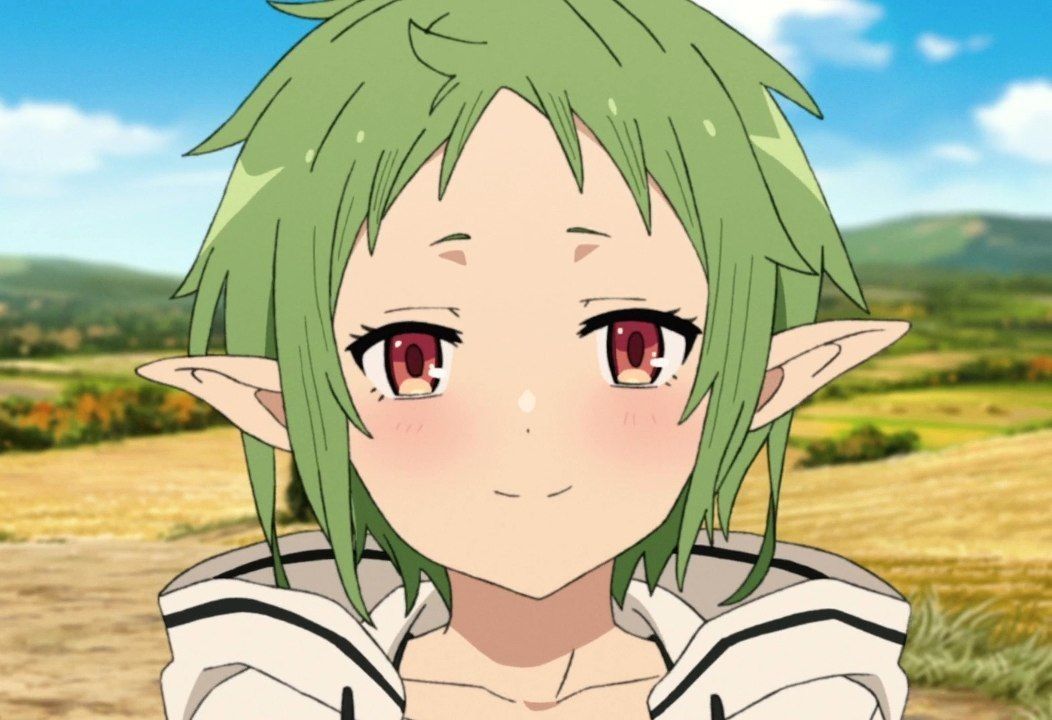
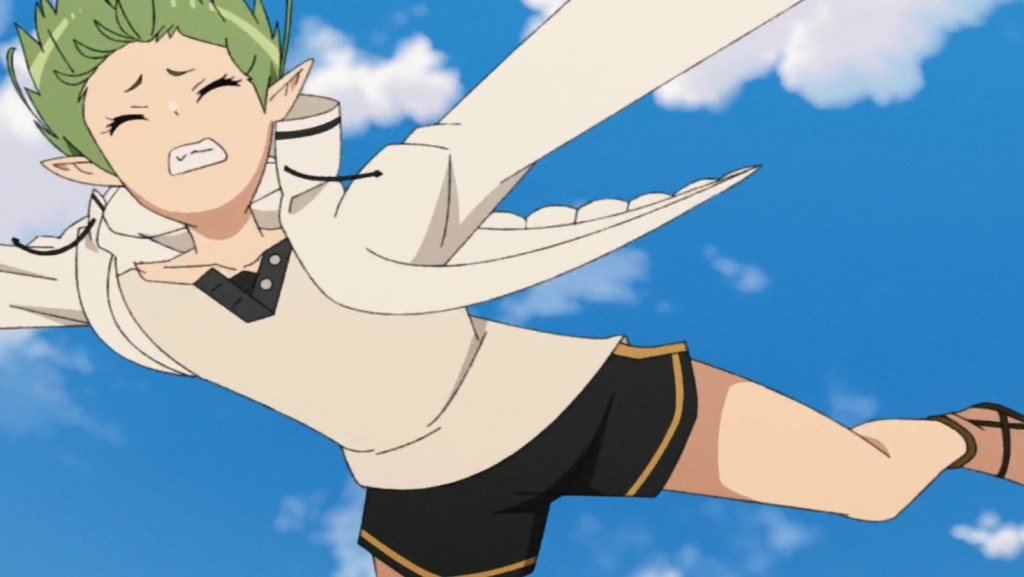
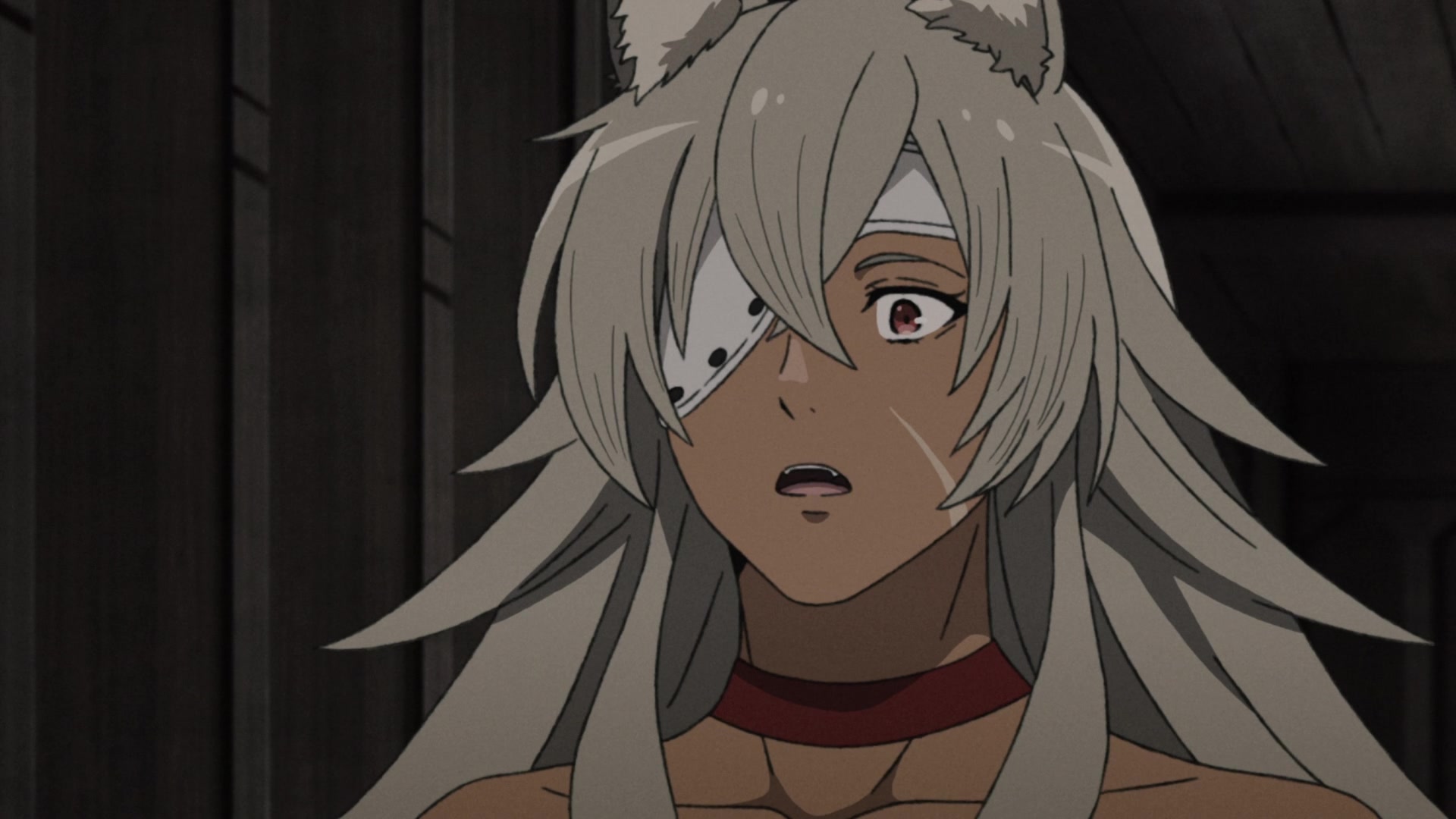
Sylphie went through a bunch of emotions very rapidly at this moment, but the overarching emotion was clearly shock. I imagine fans of this anime have shared this sentiment, and perhaps even this face, many times during this series.
I do not understand why this seems so popular to anime audiences. My cynical hypothesis is that American audiences (a large and growing and very vocal audience) are accustomed to crappy America cartoon drawing and find this “lower quality” anime drawing familiar and therefore like it more for that reason. My displeasure with the current state of American animation knows no bounds. But I also don’t think this is very likely the case. So I’m not sure what drives the popularity of shows with this combination of visuals. I do know that sometimes it works (Nichijou) and sometimes it doesn’t (Ousama Ranking), but it almost always leaves me wishing for better drawings.
But so far any negative feelings I have about the artwork have been steadily being overtaken by the vast number of positives in this series. There are a lot of questionable items in this anime, the artwork perhaps being the least questionable of them all, but there’s a lot of really interesting, really high quality, and really entertaining stuff going on too. I like this show and what it’s trying to do, and certain aspects of it are very good. I’m a fan.
We should get a S3 and beyond more than likely. There’s plenty more for the studio to draw from. I have on good authority that the manga follows Rudeus into adulthood. Nightmares of Boruto aside, we’ll see how long this goes and how interesting it gets. I look forward to the next season. More Ghislaine!








 Anteiku Anime Reviews
nice job
LikeLike