A true anime fan’s anime. Perfect from start to finish and throughout every aspect, this is 100% an anime that an anime fan should like. Hawk, are you becoming one of those critics whose tastes have diverged so irrationally and wildly from the mainstream that you “like” works that the general public doesn’t appreciate? You know, like the Academy in […]
A true anime fan’s anime. Perfect from start to finish and throughout every aspect, this is 100% an anime that an anime fan should like.
Hawk, are you becoming one of those critics whose tastes have diverged so irrationally and wildly from the mainstream that you “like” works that the general public doesn’t appreciate?You know, like the Academy in Hollywood? Have you become that? I hope not. A big part of my evaluations of anime is how they are received by the public. I don’t fancy myself as so great a judge of art of any kind that somehow my single opinion is more valid than a large group’s consensus opinion. So in the many factors I take into account in my reviews, public opinion is a big part.
However, nothing holds true in every situation, and we all know of anime where often the mass opinion doesn’t reflect the true quality of the work in question. This is definitely one of those shows. While Otaku Elf was unexpectedly more popular than anticipated, this show was cooly received by the anime community at large with only a few sizable groups of enthusiasts popping up here and there that really liked it. As much as art is a subjective experience, I nevertheless argue the general public is wrong on this one, and an objective opinion must be posited in favor of this show. I don’t say that very often, about anime or anything else where opinion is strong, but when I do say it, I very much mean it.
And the reason this show is objectively good is because it’s exactly the kind of work that exemplifies anime. It’s beautiful, it’s heartfelt, it’s sweet, it’s unreasonably unreal, it’s lively and energetic, it’s creative, and above all it’s very Japanese. Sure “anime” is Japanese, but not all of it flexes its culturally Japanese muscles the way some do. This one does, and, startlingly, in ways reminiscent of some very legendary anime titles.
In a packed Spring 2023 season when this show had to compete with wonders like Insomniacs After School and Heavenly Delusion (while it still had its sheen) and with sweet shows like Skip and Loafer and The Dangers in My Heart, not to mention the tsunami caused by Oshi no Ko, I ranked this show pretty high on my list. To be so simple and sweet, it had the power to keep my attention and make me want to see more of it. Perhaps the best way to describe it is to say that I never stopped smiling while I watched each episode. I’d watch that amazing, silly OP, I’d watch the characters interact with the elf Elda, and above all I’d watch that strange, sweet, detached, listless face of Elda herself, and I couldn’t help smiling brighter all the time.
I still smiled when I finished this series, but then it was a sad smile, for I was sad to see it end. So much so I started watching it again almost immediately, which is so unusual for me that it actually never happened until I watched this anime. I hope for a second season. It could go either way in that regard, as it’s pretty open-ended. But this show would be at the top of my watchlist if it ever does get a second season, that’s how much I loved it.
Material covered: Season 1, 12 episodes.
⭐⭐⭐⭐⭐
Rating: 4.5 out of 5.
Characters
Rating: 8
“Tsukishima, Chuo City, Tokyo. Spanning more than 400 years since the Edo Period, is Takamimi Shrine. The goddess summoned from another world enshrined here…was an absolute social recluse of an elf.”
I sympathized completely with Elda from the first moment I saw her.
I’m not an otaku. I realize the term is thrown about casually outside of Japan, while inside Japan it’s very much a pejorative, but regardless of the sense of the word it does not apply to me. I just love anime, and I can do so without bearing any resemblance to the obsessive creature that is the otaku stereotype (I love you all by the way). Nevertheless, nevertheless, I totally felt Elda was drawing me into that world. I felt her pushing me towards my room and its comfortable furniture, inducing me into buying gallons of cola (a little Himouto! Umaru-chan reference there for you) and gluing myself to my screen and computer. I understood her. Everything she did, as extreme as it was, was all very familiar to me as if I’d done it myself. This was funny and slightly weird all at once. Nor am I sure exactly why I felt this, but I’m pretty sure it was powerful enough of an effect that other people probably felt it too.
This was one of the first reasons I began to think that this anime is one that anime fans should objectively appreciate. We probably all feel a little like Elda at some point in the career of our love affair with anime. The true anime fan will recognize her tendencies and probably will feel inclined to behave the same way to varying degrees. Maybe that was Elda’s magical power after all.
If excessive comfort was ever banned in the Edo Period, Elda would be in trouble.
Elda enchanted me. Her face, her mannerisms, those amazing long ears, and that tinge of otherworldliness made her fascinating. Her otaku-ness had both the effect of making her sympathetic to otaku-ish audiences and of making her feel detached from everyone else. This very likely contributed to her otherworldly feeling a little. There was always just a little distance between her and everyone else, a distance that couldn’t be covered no matter what. Otaku or otherwise, many of you can understand this feeling even if you aren’t from another world. You might laugh at it or feel sad over it, but it nonetheless made us sympathetic with Elda. I wonder how much of this was intentionally incorporated into her design by her creators.
For a number of reasons I won’t go into here (or anywhere else very likely, try me) I really like elves in anime. As long as they’re not that loli variety, I’m a big sucker for these long-eared creatures and their strangeness. The dark elves get me going one way, but even the fair ones like Elda have a different and unique appeal to me. Elda was a wonderful example of one of the kinds of anime elves I like the most. She was tall and stately and her eyes were the window to a soul beyond our human comprehension. She was beautiful but in a different and unusual kind of way. Her slumped posture was unusual for her character type, which made it hilarious, and it even added to her sweetness.
Her detachedness and her nervousness made her even more lovable. The way she hid behind Koito, her miko and co-main character, or behind objects like pillars or doors whenever someone she didn’t recognize was around was absolutely hilarious. That nervous look on her countenance never got old. More on her appearance in the Artwork section.
“Nai. Soto kowaii,” Elda declared stubbornly. The way she talked was hilarious.
I love love love the way she halted in her speech. She would regularly stumble over the first syllable of the first word she spoke whenever she started talking, and it was adorable. And all of this was pulled together by the magnificent performance from Elda’s VA, Ami Koshimizu. She’s been around a bit. She’s Holo in Spice and Wolf. She’s Kallen in Code Geass. She’s Schokolade in Jormungand. Of course her greatest role is as Ryuko Matoi in Kill la Kill. In Spring 2023 she played Kilmaria in My One-Hit Kill Sister, where she used a very similar voice to Elda’s here, and where she got my attention initially until I picked up this show and the rest was history. Koshimizu is highly talented, and she made Elda even more perfect than she already was.
This show was unexpectedly really good, and Elda was the number one reason for that without any doubt. Her mannerisms, her posture, her speech, the things she said, were all hilarious and were the dominant features of her character. But mixed into all this was a mix of separation and sadness that was unmistakable and certainly intentional from the authors. She was both a very sad and wildly hilarious character all at once. You don’t see that very often. That was beautiful.
The supporting cast was a mix of pretty strong and meh. There were two other elves in this series who were also, and equally inexplicably, summoned to this world during the Edo era. Yord was one of these. She was absolutely hilarious. She so wanted to be the “big sister,” the onee-san, to Elda, being a few years older (both in their 600s and looking great), but she was not only really small in stature compared to Elda but was even more childish than Elda. Elda was immature in the way she was afraid of people and loved her games and toys (call it childish, call it immature, it was adorable), but Yord was just immature all over. The childish voice of this crybaby dark elf was supplied by the inimitable Rie Kugimiya, who has done many wonderful roles over the years such as Alphonse Elric (Fullmetal Alchemist), Happy (Fairy Tail), and little Koto in one of my hidden-gem favorites, Kyousou Giga. She’s loud and energetic and babyish here as Yord, and it’s wonderful. Yord is only in one or maybe two episodes, but she’s magnificent. She’s the only person in this show to even begin to challenge Elda as the dominant character in her scenes.
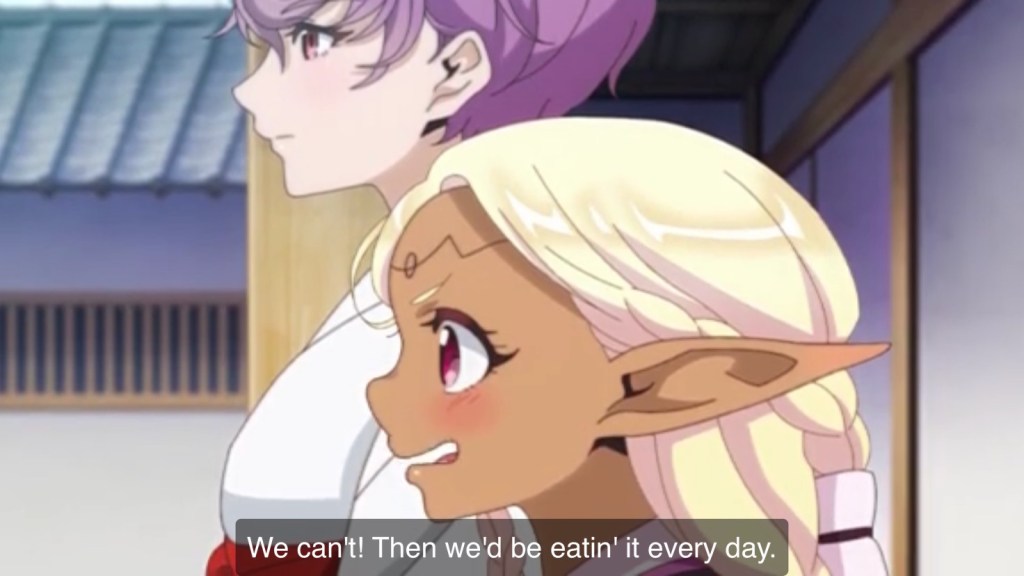
Yord and her miko, Himawari, briefly discuss takoyaki and how it’s associated with their region, and how they don’t eat it every day despite the stereotypes. Then they end up wanting it and Yord says this. Rie Kugemiya with that Kyoto-Osaka dialect is hilarious.
The other elf was Haira, She was slightly older than both Yord and Elda, and so slightly more mature. Though this applied to her faults as well, as her particular fault was gambling. That episode where she showed up with a weed as a gift (saying it was a healing herb, which it may or may not have been, but it was still a weed from the side of the road) after she’d spent all her gift money on gambling, unbeknownst to her miko, was hilarious. Her character wasn’t as fun as the other two elves by far, but the gambling thing was funny.
A miko is apparently just a shrine maiden, a character type we see fairly often in anime and a traditional Japanese position in society. Feel free to look up the term, as it is not as rosy a profession as it’s made to appear here, particularly in the far past, but I need not trouble you all over that here. In this show each of the elves hailed as goddesses are attended by a single miko.
Of these three miko Koito is Elda’s attendant and the co-main character of this series. This character was probably more difficult to write than we might imagine. She’s essentially an enabler character, in this case for Elda. She’s the foil to Elda’s otaku-ness, always fuming with her about her habits and tendency towards inertia. As such she has a role to play that makes it slightly difficult for her to assert herself within the story. She had some fun lines as the foil for Elda, but most of her dialogue was deadpanning Elda’s goofy talk, yelling in frustration at Elda, expressing interest in Elda’s historical accounts, or dreaming about the future. None of that is a problem of course, but I wonder if it’s a problem that I can so easily categorize her dialogue.
Elda tells Koito, in so many words, not to say such things.
Her VA is just okay too. Although I’m not really too bothered by that in this case. Yuka Ozaki has only had a brief career in the seiyuu world so far, so I don’t hold the mild stiffness against her. Just like this character was probably harder to write than we might think, Koito was also probably a harder vocal role than we imagine. There wasn’t a lot of room for her to be much other than exactly what her enabler role made her, so I imagine that might make things a little difficult for even an experienced VA. So keep at it Ozaki-san. Whether this was a great performance or not, this was a great show to be a part of.
Speaking of VAs with little experience, I remember listening to Kana Ichinose in her very first role when she played Ichigo in Darling in the Franxx. That’s a hell of a show to get your debut in. She was super green, as they say, but she was also unmistakably one of those talented actors you couldn’t miss even through all the clutter of her inexperience. She has a remarkable voice, and has put that to great effect with characters like Sayu (Higehiro) and Maki Shijou (Kaguya-sama: Love is War). She does a great job as Haira’s miko Isuzu Koimari here in this show, playing an emotional character who’s troubled by the fact that her goddess will live eternally but she will eventually have to depart from her, a big aspect of this show that I’ll get into more later. Ichinose’s remarkable voice makes Isuzu feel young, growing, and troubled, but also happy, and even funny at times like everyone in this show.
Speaking of first ever roles, this was the first role in anime for Haruka Aikawa, playing Koito’s gyaru friend Koma Sakuraba. This was the one bad vocal performance in this show. She overdid it badly. Her gyaru-speak was very overemphatic. She spoke much too slowly (even for animation voiceover, which is notoriously slow, something I always deplore) and way too clearly, especially for a gyaru character. Not only are gyarus known for their unique lingo (nearly its own dialect at this point) but also for their poor diction. This usually is characterized by monotone and often slurred speech, making them almost unintelligible to the foreign Japanese speaker. Anime deals with this in various ways, usually tending towards retaining the lingo while casting aside the slurred speech, often simply having the VAs cut off their words a little here and there in reference to this vulgar style of speech. Aikawa-san has some of the lingo per the dialogue of course, but speaks very slowly and very distinctly, yet in the freewheeling tone we often hear in gyaru characters. I didn’t like it. It is her first role so I can’t complain too much, but it bothered me still. It wasn’t a great start for a seiyuu.
Koma had this weird repeating comedic device where she’d transform into the sterotypical “anime hot guy.” I didn’t get it, but there it is.
One remarkable feature of this show is that there are zero male characters. Grandpa doesn’t count. We see the hem of his garments one time, the rest of the time he’s present but separated and invisible. It’s a small cast, but it is all female, and not all the waifu types either. It just is what it is and it works.
I won’t get into the remaining characters like the two adults, the doctor Akane Sakaki and the restaurant owner Kirara Kadoi, who are fun but only appear here and there, or little Koyuzu, Koito’s little sister, who does all the cooking. Oh, I almost forgot about Himawari, Yord’s miko. She was really funny, mildly indulging her wild goddess with a straight face and a quiet tone. Where Koito had to wildly corral Elda, Himawari quietly guided Yord like her big sister, was which was funny because Yord wanted to be the big sister to Elda. Good writing here.
So it’s a mixed bag of characters, but overall they’re great. The studio opted to go with some very new performers in certain areas, which has its merits for all involved, but it showed here and there. But that’s so overshadowed by the great showing from Elda that I don’t mind it in the least. Elda is everything in this show and she aces that role. Because of her everything in this show is better, and certainly that applies to the characters. They’re all pretty good, but she makes them all great.
Artwork
Rating: 9
The artwork found itself in a slightly unusual place in this show. Usually I view an anime series as either centered around its characters, its story, or its artwork, with the remaining two aspects supporting that. Otaku Elf wasn’t particularly centered around any of these. The story is simple and obvious. The characters are great but not wholly the focus of the anime. The artwork isn’t the focus either. It’s very pretty but, as I shall discuss below, its scope is very limited.
Instead this show is all about the presentation, and by that I mean the presentation of everything together. In my opinion, that means all three elements of characters, story, and artwork carry equal weight and importance in creating a final product that is the feature itself. That seems like a fine point—isn’t the point of all anime the final product itself?—but this focus on the “presentation” of the whole put the artwork in a peculiar place. It had to be good but it only had to be good in a very few ways.
This artwork isn’t beautiful like some shows. It doesn’t even begin to approach the beauty of shows like Violet Evergarden or Fairy Tail with their unique kinds of beauty. Yet it undeniably is anime beautiful, to coin a phrase. The reason I think it’s not beautiful like we expect of anime artwork, and also the reason it’s nevertheless beautiful in an anime kind of way, is all because the entirety of this show’s artwork focuses entirely on a single aspect: faces.
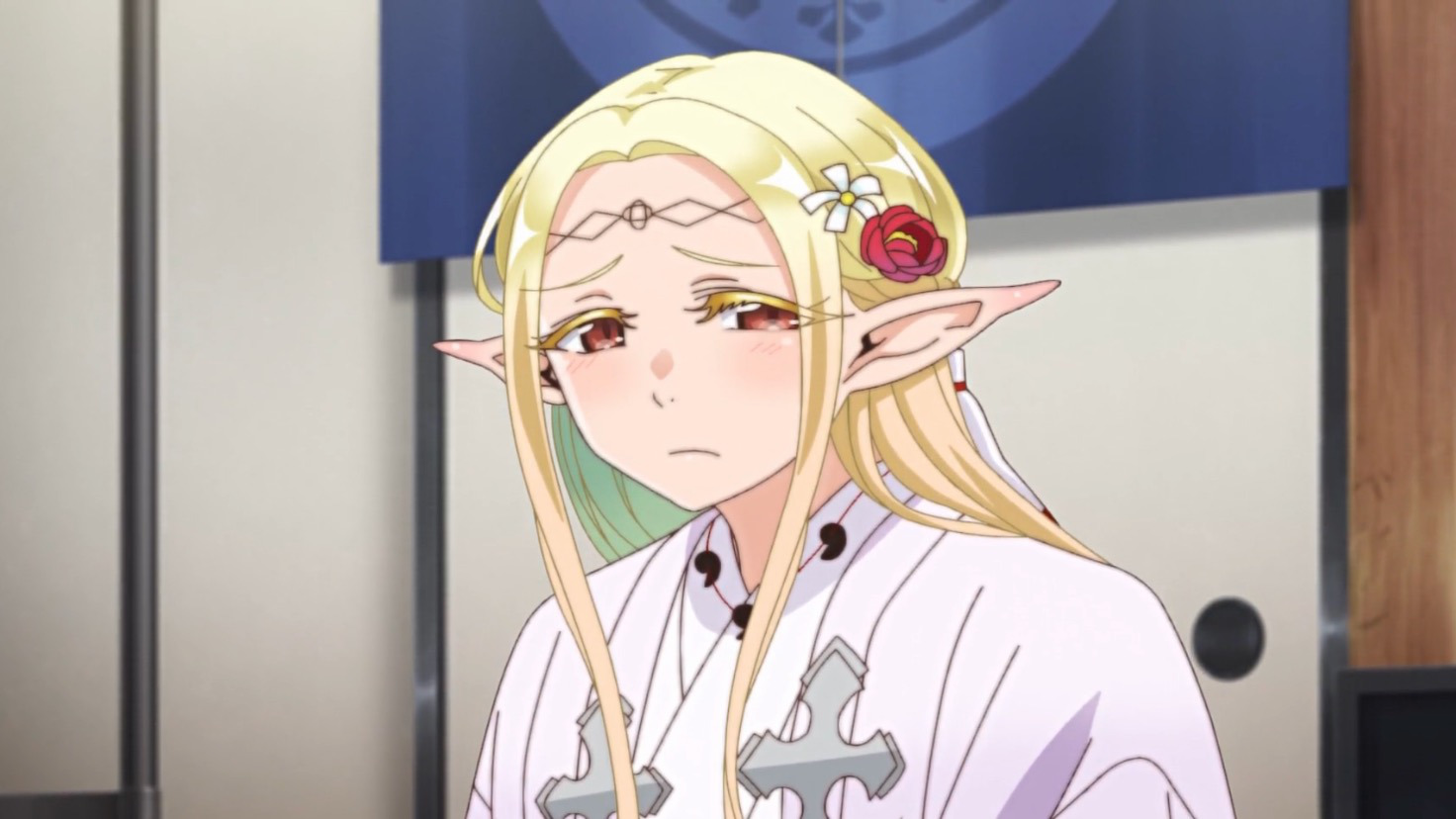
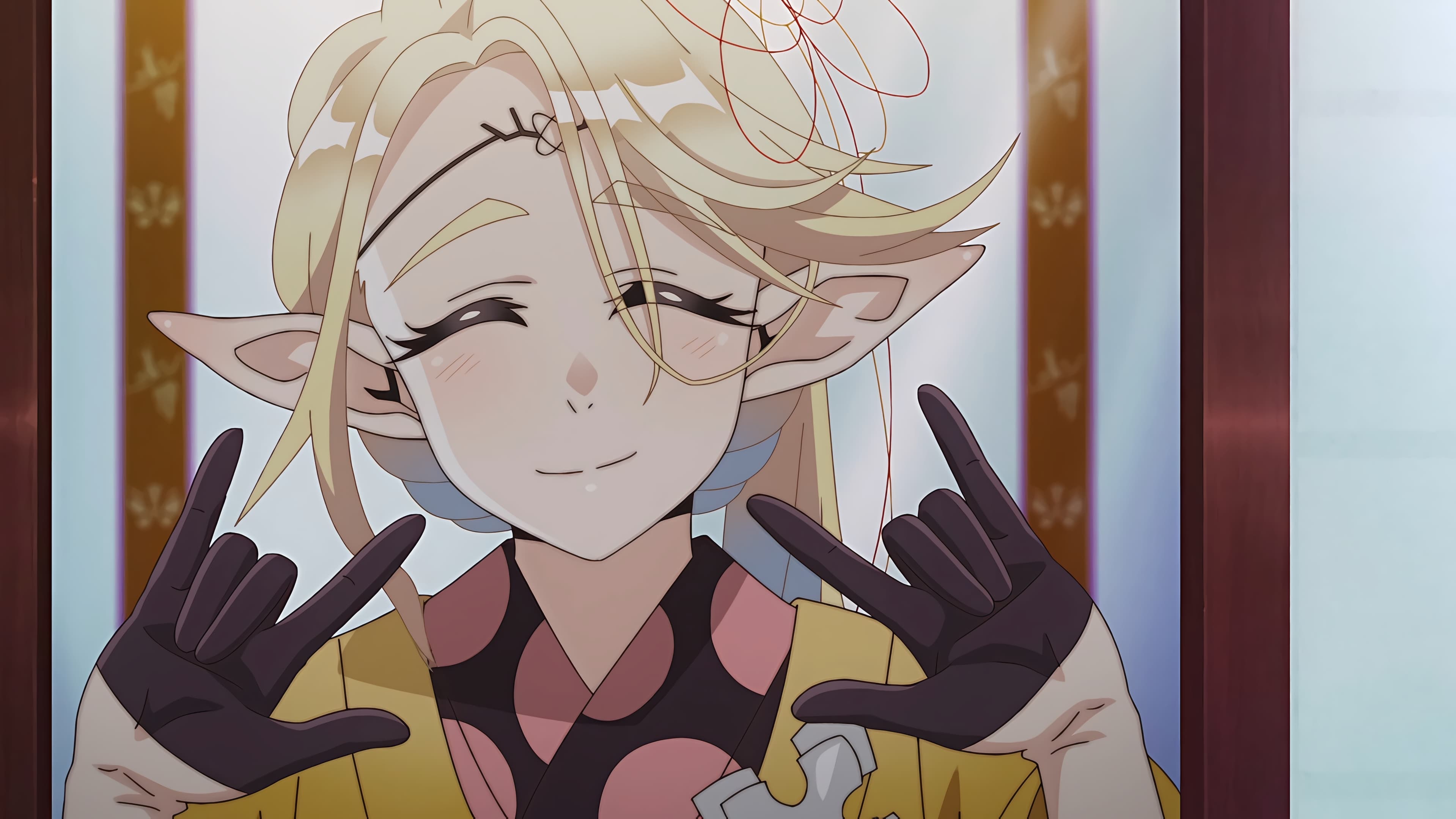
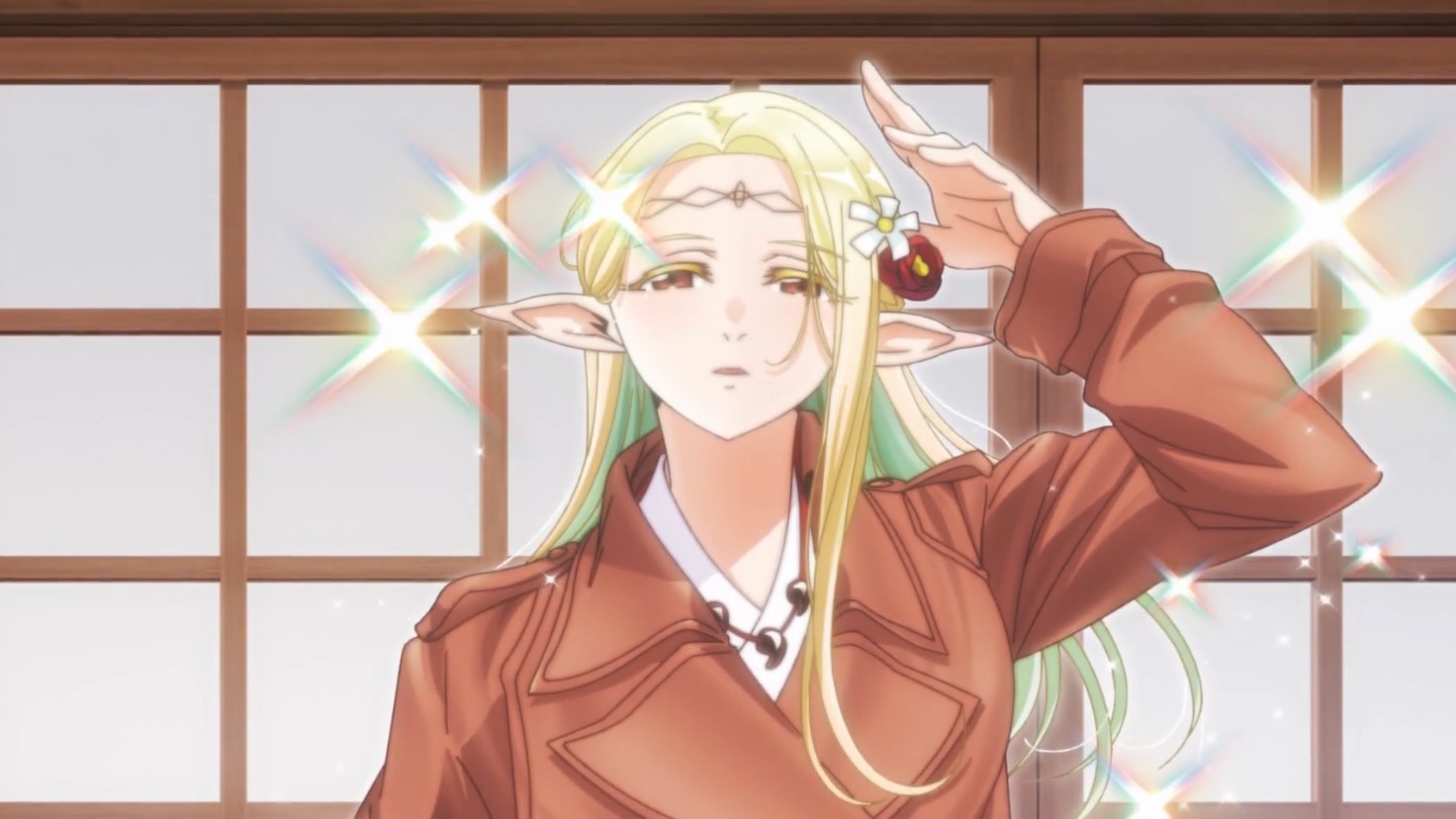
A moment where the lack of confidence vanishes for a moment and the ageless, beautiful face of Elda shines forth. Note the reflections in the eyes and the shining strand of hair.Elda’s eyelashes are gold, not just blonde, which was another nice touch. Then there are the pointed ears, which I adore.She’s magical.
I talk a lot about anime being all about eyes, but this show goes a little further and makes its focus entirely about faces. In particular, it’s focused entirely on reactions and the displays of emotion we can see on faces. A lot of that is familiar to us. Some reactions occur on the characters’ natural faces, often extreme shock or smugness or happy smiles. A lot more occur on “reaction faces” in this show: simplified sketches of the characters pouting or (Elda) reacting fearfully and reticently to events taking place around her. A good example is the > < eyes, where any semblance of actual eye shape is thrown out the window and replaced by those two-thirds of a triangle. We see a fair amount of stuff like that in this anime. Elda in particular we see very often with a very ovular face and warped, bubblish cheeks. All of this is very anime-typical for emphasizing comedic reactions in characters. I imagine very few would describe that as beautiful, but would instantly laugh at most of it in a happy, familiar kind of way, as we know this is an anime thing that we all know and love.
But there’s another aspect to this extreme focus on faces in this anime. These faces often show very subtle reactions as well. Elda is the main focus of this. This is where the bridge between silly comedy and the more profound, dramatic areas of the writing in this show begins to build. I could describe many instances of her showing suppressed emotional reactions to things. You can just barely, though unmistakably, tell what she’s thinking by the look on her face. But instead I will describe my favorite usage of this subtleness of expression in her face.
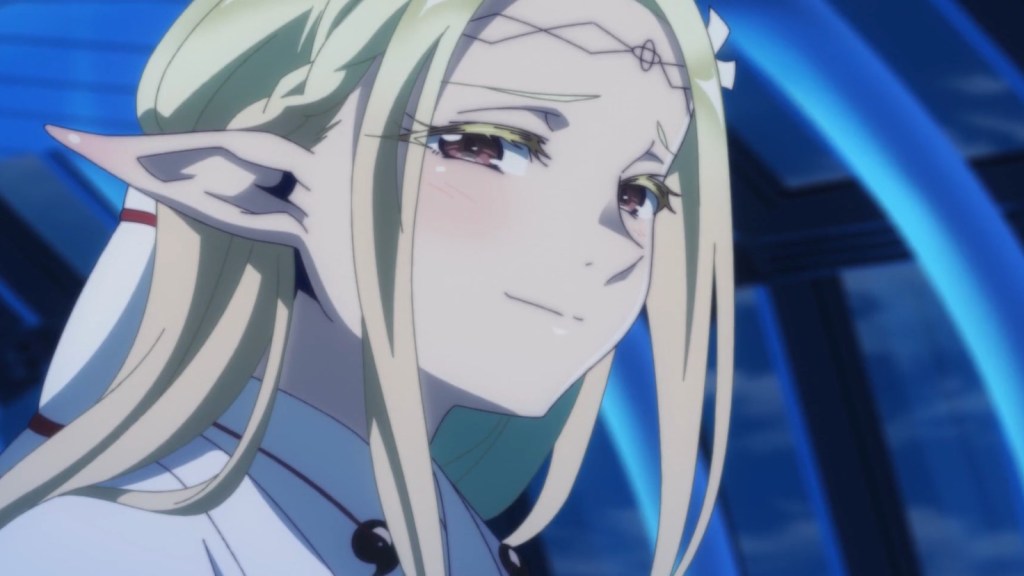
In an episode of this series, Koito remarks that occasionally she sees this peculiar smile on Elda’s face, and that she doesn’t like it. This revolves around the story aspect of Elda being immortal and those around her not being so. When Koito is talking about this we’re being shown Elda’s face making that particular smiling face.
That face is otherworldly. That’s the only way I can describe it. There was some emotion in it that we don’t have a name for. She was clearly smiling, but it wasn’t a happy smile. Nor was it a smile forced through sadness. It wasn’t a practiced, unnatural smile. It was a smile that meant nothing, but that meant everything. It was remarkable. It was amazing. It was beautiful. Between the manga and the anime, the artists did an unbelievable job on this aspect of Elda’s face. While that instance is the primary time we see that face, she generally had a lot of subtle reactions and just normal faces that seemed very strange but also very pretty or even very funny. It’s very well done.
Making Elda look otherworldly in this subtle way was a crowning achievement in my opinion. The artists could’ve just made an elf. We’ve all seen lots of elves in anime. But they didn’t. The art director for the anime dug deep here and created something I must say I’ve never quite seen the like of before. Elda’s detachedness is twofold in this show, one being her otaku-ness (comedic) and the other being this immortality that continually cycles her through friendship and loss (dramatic), and the artists for this anime depicted both of these aspects perfectly in her face. The more I thought about this the more wonderful it seemed. This was top-tier anime artistry.
On the third of three pulls…Elda pulls another common, the Tadpolecopter. She’s just a wee bit obsessed with Frog Tanks. Her disappointment is immeasurable and her day is ruined.
And it was perfect for this type of anime. The artwork focuses entirely on faces in this show, aforementioned. There’s little animated motion outside of facial reactions. Keyframes for faces were critical, and the art team nailed it. Instead of focusing on making extraordinarily beautiful faces or eyes even, something you commonly see in face-focused anime (a peculiar stratification, but a relevant one for sure; think Kaguya-sama: Love is War, Horimiya, Non Non Biyori, or Nichijou, then consider how successful all those shows are and why), they chose to focus on reactions and on subtlety in expression, and even on creating this strange, otherworldly appearance on Elda to emphasize the key elements of this tale. That’s great anime work. It’s a little thing, maybe even one of those things that’s too fine to warrant notice by a casual viewer (which is fine), but I noticed it, and I loved it.
This is what I mean by the artwork being part of the greater presentation of the whole here. This show is about an otaku elf who has become that way partly in a comedic way but also partly in a very sad way, and the artwork perfectly supports that premise. I can hardly talk about the artwork without mentioning the story and the characters. That isn’t often the case in anime. Art style is always meant to match the particular anime or genre they belong to of course, but it’s done exceptionally, and perhaps even surprisingly, well here.
Apart from that, I enjoy the colors, which are subdued but lively, I enjoy Elda’s design, her slumping shoulders and timid eyes and those gorgeous long ears, I appreciate the liveliness of the young people’s faces around Elda, and I even found the occasional shift to those scrolls with the traditional Japanese art on them depicting Edo Period events as Elda described them kind of interesting. But the biggest part of the artwork that stood out to me was the wonderful job with the faces, Elda’s in particular, and that makes this artwork wonderful all by itself, and most deserving of high praise.
Story
Rating: 8
The core story is simple to nonexistent: this elf was summoned by one of the key historical figures in the Edo Period during the establishment of the Tokugawa Shogunate and was subsequently enshrined as a goddess, and since then has been “worshipped” as such in her shrine, attended by her miko, throughout the centuries, all while she earnestly and strenuously seeks to avoid any contact with the outside world in her introvertedness. Her reclusive behavior has evolved into a modern and recognizable form of “otakuism,” complete with a room full of figurines and toys, shelves upon shelves of manga, gaming devices scattered all about, and long binges of anime on the TV.
In the midst of that mess sits the supremely unconfident Elda, the summoned and deified otaku elf. And there the story evolves from this simple premise and this humble form of a character into a nuanced tale of comedy and sadness that I completely didn’t expect to be treated to when I started watching this anime.
Elda’s shut-in behavior is the key focus. Several repeating comedic devices surround this element of the story, most of them revolving around her not wanting to set foot outside, making poor money choices in her pursuit of otaku merch, spending excessive time in single activities, and neglecting her official duties as a goddess in favor of her otaku behaviors. “Repeating” is an understatement. Almost all of these comedic devices appear in every episode.
Elda was her normal, unconfident self around the visiting Haira until Isuzu, Haira’s miko, mistakenly called one of Elda’s figurines a robot. In deadly otaku seriousness, Elda corrected this misguided child.
If there’s one glaringly obvious charge one could bring against this show, it’s that it is repetitive. Elda doesn’t want to go outside. Elda can’t speaking without halting. Elda can’t speak loudly. Elda is crazed for Frog Tanks (yep). Elda eats snacks all the time. If none of this stuff was funny to you the first time, it’s not gonna be any more funny after the fiftieth time. But oddly enough, it not only was funny to me the first time, but it continued to be funny to me despite definitely being repetitious. I recognize that some might find this frustrating and certainly appreciate that. I personally enjoyed the repetitiousness in this case.
Each episode has a new adventure for these characters. The early ones establish the main group of characters, the middle ones develop these characters and allow for the addition of the handful of new characters, and the last ones simply continue the pattern and show off the characters. Usually these adventures had some crazy component to them. Elda gets a smartphone in one of them and drives Koito crazy texting her (in lieu of her “spirit” messengers who abandon her suddenly and temporarily). The episode where Elda and Koito have to climb to a high place (a tall building in this case) for a ritual is the one with the strange smile scene I mentioned above. The last one with the arrow-shooting ritual was hilarious because it seemed like such a terrible idea for this crazy group of characters. Elda, being an elf, obliges the stereotype and is proficient with bow and arrow, which was fun, but Koito, who is supposed to do the shooting for the ritual, is equally and oppositely untalented with them. All these displays were pretty funny and allowed the characters to show themselves off all throughout.
We were treated to these occasional frames where the characters conversed via insets. Elda usually had some smart comeback, delivered with maximum low confidence, to some observation from Koito.
But not everything in this show is funny. It has some really sad moments. Almost like reality checks, strange enough, given this show has a supernatural aspect. The biggest of these of course revolves around Elda’s immortality. A lot of us probably thought about this at some point during the show regardless of the author’s intent to point it out, but it follows that if Elda is immortal and her miko and other associates are not, those people are all going to disappear from her life at some point and leave her behind. They’re replaced by others of course, but “replaced” is a terribly inapt word here. It’s very sad to think about. The more I thought about this aspect of this show the sadder it became.
The saddest, and also the most profound, part about this story point was that it tied directly into the main comedic premise itself. Elda tells Koito at one point that she became a shut-in not so very long ago after a little boy made fun of her long ears (obviously a misguided young man of poor taste), but the reality is that she has become more and more this way over the years because she’s afraid of making strong relationships with people because of the pain of parting with those people when they pass away while she must remain in her immortality. So her shut-in otaku-ness is prompted by the saddest part of this whole story. This is really good writing.
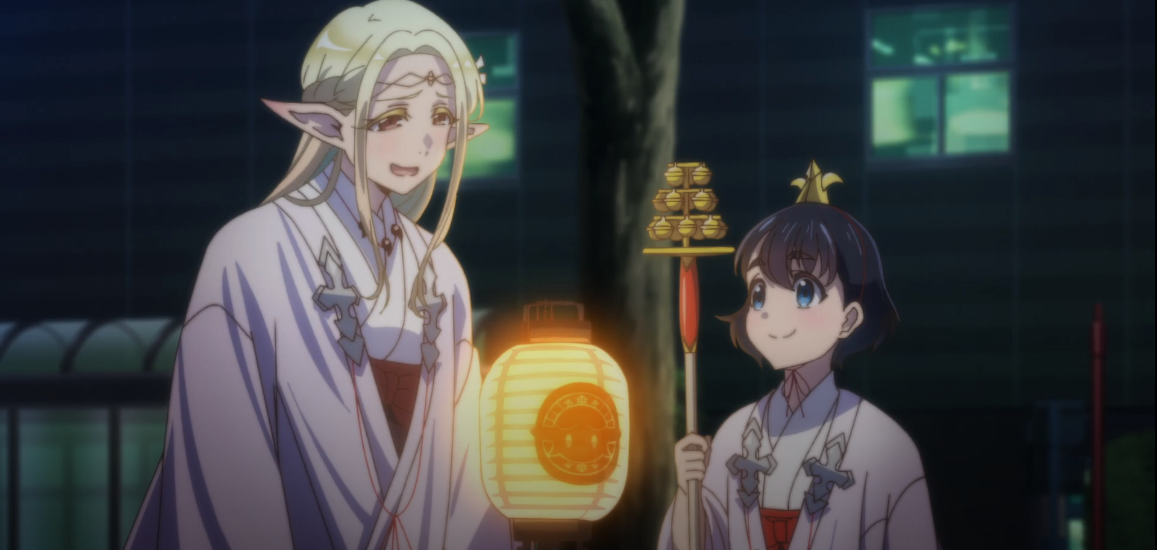
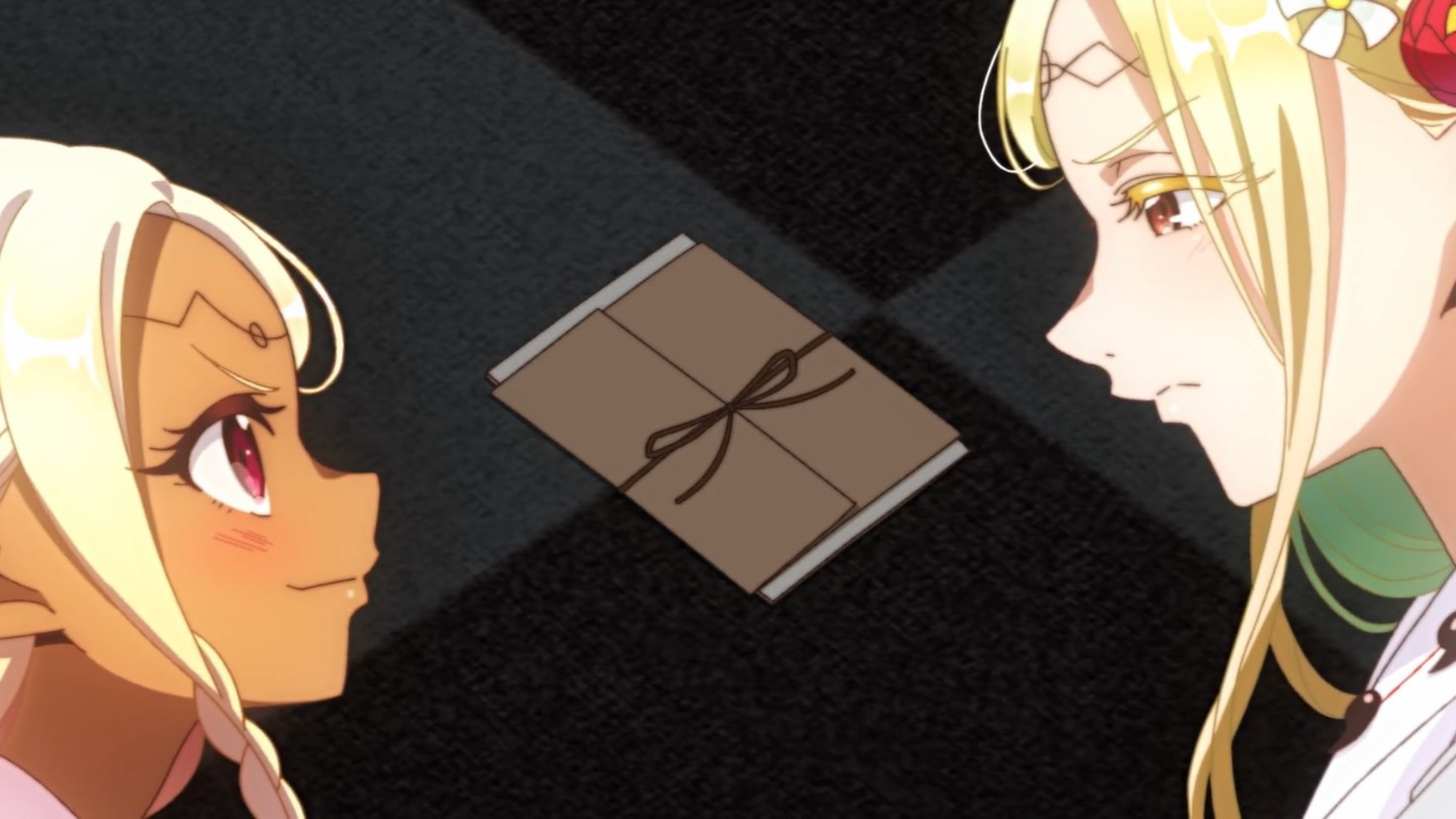
This story element connects in with a related sad part of this story. Koito’s mother, the former miko to Elda, passed away when Koito was a little girl. We don’t know anything about dad, but it’s very possible poor Koito doesn’t have any family outside her little sister and grandfather. In the very first episode, we are introduced to “the lady in white” who Koito idolizes, who she met on a night when she was little, alone and crying. The lady made a strong impression on Koito, which she remembers to this moment. Curiously but unsurprisingly, that person turns out to be Elda. It was curious because this story element was both introduced and resolved in a single episode, which was weird.
Isuzu delivered this line, the essence of the sad part of this story. Many young people deal with this question. This show put it in a new light, but it lost none of its dolor.
But I didn’t realize until it was revisited in a later episode that this night Koito was out running and crying was the night following her poor mother’s funeral. Koito ran into Elda who was, in her own, strange, otherworldly kind of way, mourning the loss herself, as one who is immortal might mourn such losses. Two very different people, living very different lives, at very different points in their lives, meet in the street both mourning the same loss, but in very different ways. Plus one for great writing. Plus one for heavy emotional impact.
As sad as all this is, it takes a little examination of the work itself to see some of it. It’s there but it isn’t glaring at us. What I mean is that while all this is sad and has its effect, it doesn’t affect the tenor of the show so much that the whole thing becomes sad. The show is comedic overall, and maintains that feel continuously while lapsing occasionally into these deep moments.
One of the ways this show maintained that comedic feel was with “passive” elements like the names used for people and places. The shrines all had funny names containing the word “mimi.” Those familiar with Japanese will recognize this as the word for “ear” of course, which makes sense. Elda’s shrine is called “Takamimi,” which, best I can tell, basically means “long ears.” I’m not sure about the other two shrines as I only researched about the one, but my guess is they’re similarly humorous in their appellations. And I don’t remember the details right now, but I seem to remember a couple of the rituals had funny names too. I’ll have to go back and check on that, but feel free to comment and tell me if you know anything about that or any of the names in the show.
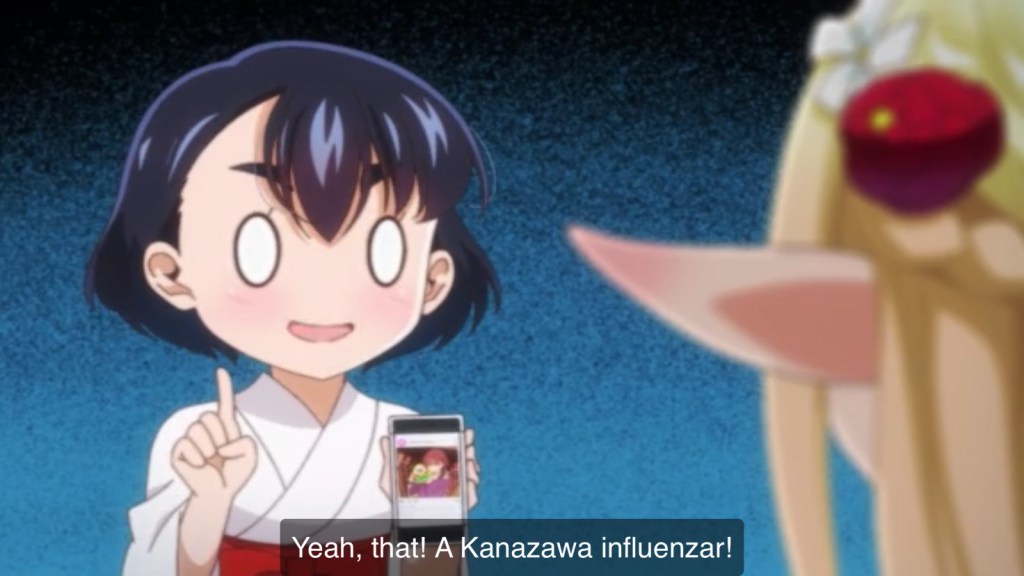
Koito tries to use the English word “influencer.” Elda remarks afterward that Koito is bad at using “loan words,” which is funny because Koito, being younger, you’d expect to be better at using modern Japanese phrases, borrowed or not, yet it’s Elda that can pronounce this word and not Koito.
I have mixed feelings about the history tidbits they mixed into this show. Elda was summoned back at the establishment of the Tokugawa Shogunate, and by none other than the principle historical figure of that cultural shift in Japan, Tokugawa Ieyasu. This timeframe spanning from there to the Meiji Restoration is perhaps the most major historical timespan in modern cultural Japan’s history, and plays a major role, in many different forms, in many famous anime such as Rurouni Kenshin, Gintama, and One Piece.
Not being Japanese and not wishing to stray into the real world here, I will simply say that this show portrays that era matter-of-factly and without judgement, Elda often remembering back to those times and all the little rules the shogunate implemented on its whims. It seems like a rather bleak time from my perspective despite the unification it brought to Japan, so while it was interesting to hear some of the history, I got pretty tired of hearing how oppressive it seemed. I can see why Japan changed so much after enduring all that and everything that they went through before it for so long. I stray.
Other than that, and that being just a personal thing, I love the way this story is written and unfolded. It’s simple at heart but clad with some wonderful pieces that make the whole thing beautiful. In a series that would have probably been perfectly fine as simply a character-driven show, we get these nice story elements that not only highlight the characters even better but also give us those unexpected anime feels, which sometimes are the best kind.
Overall: 9
The music as a whole is lively and effective but certainly meant for the background. Other than the OP. The OP is wonderful. The OP is amazing. Actually it’s one of the best I’ve seen in a long time, in my opinion. That’s pretty unusual to say for a comedy. I thought it was perfect. While many anime are adapted form original sources, OPs and EDs are all original material, and often tell you a lot about the creators behind the anime at hand. Otaku Elf is adapted from a manga, and this wild OP says a lot about the creativity of the people working on this anime. The song and the visuals both perfectly captured and enhanced the tenor, both the sad and the happy, of the show. I loved the mix of modern and traditional in the music and singing.
And the visuals—oh lordy. I can remember it now. Elda gaming with an angry Koito behind her, who surprises her in an angry outburst, whereupon they chase wildly around the kotatsu in the middle of Elda’s messy room until they’re both wobbly, spinny-eyed dizzy. Elda walking along with a baby Koito, a little girl Koito, and a teenager Koito at the end, never changing herself. I’d smile bigger and bigger through the whole thing. And for an ever shifting reason too. It’d start as pure fun, then switch to hilarity, then to that warm but slightly sad but sweet feeling, ending with just satisfaction and happiness.
My favorite part was one frame at the beginning. We see each of Elda’s ears in turn wiggle up and down, then in turn we see Elda gently grab each of Koito’s ears in her fingers and pull them just a little to make them longer, then we flash to this full frame with Elda standing behind Koito, Koito’s ears in each hand, making this idiotic, smug, self-satisfied face, while Koito stands in front and smiles in immovable resignation and indulgence. I’d laugh out loud every time I’d see it. I laughed now just remembering it.
This is one of the best frames I’ve seen in anime in a long time. And that’s up against a hell of a lot of competition. It may not be better than some of those, but it’s right up there with them. Ask me for examples of some of those frames and we can debate this.See full OP below.
Full OP. Somebody let me know if this thing doesn’t work right. The full length song is really nice as well if you wanna go check that out (“Kien Romance” by Akari Nanawo). This is wonderful work by the people at C2C Studios.
I want some grape Fanta now. We had the typical off-branding we see a lot of in anime here in this show, except for occasionally we’d see a real brand, which was weird. Why they could use the Red Bull name but not Amazon or Fanta is confusing, but it’s a nice, funny kind of confusing.
Why is this an anime for the true anime fan, you say? If you’ve got a few minutes and are possibly furious at this idiot writer for claiming this rather ordinary anime is so great, I’ll make my case.
I’m gonna go out on a limb for this show a little bit. One of the reasons this show is great in my estimation is because it exemplifies a type of anime. By that I mean different anime exemplify different types of anime. By extension of that I mean that hardly any one anime exemplifies “anime.” One Piece and Dragon Ball cannot be compared easily to Sailor Moon or a Ghibli film, for instance, yet all of these could be said to exemplify anime. So they simply exemplify a type of anime. This is a source of great controversy among those of the world of anime, since people often skip right to claiming their favorite anime exemplifies “all of anime,” in so many words, when they more accurately should say it exemplifies a type of anime.
Hide the kids, the adults are about to argue online.
This is not to say that certain anime do not exemplify the medium. I think the Dragon Ball series, the Monogatari series, and even Neon Genesis Evangelion can make some claim as being the anime of all anime (here in 2023 One Piece is starting to make a legit claim for that title as well). I’ll listen to those arguments all day, and even make some myself, especially for Monogatari. But debate that question as you will, there’s no question that each of those shows and others like them exemplify certain types of anime. They are at the peak—I see that word overused so much these days—of their genre or even a less clear categorization. Perhaps some of them exemplify and define a type all by themselves.
As far as those types are concerned, let’s throw some names out there for context before I get back to Otaku Elf and wrap this up. One Piece, Dragon Ball in action/adventure shounen. Sailor Moon and Madoka in mahou shoujo. NGE in mecha. Tokyo Ghoul in horror/gore. Attack on Titan in drama-battle. Gintama in pure comedy. Toradora! in modern rom-com. Cowboy Bebop in sci-fi Western (yep). Fairy Tail in fantasy. Your Lie in April in romantic drama. Monogatari in supernatural. Monster in mystery-suspense. Now all of you let loose on me in the comments.
Hawk, seriously, Otaku Elf goes in the same kind of category of categories with these series? Yes. I’ll tell you why. Because I threw out clear categories there, a lot of big names fell right to the top. What category does Otaku Elf fit in? Comedy? Never gonna pass shows like Monthly Girls’ Nozaki-kun or Non Non Biyori, much less Gintama. Slice of life? Ahaha…as in Your Lie in April, Great Teacher Onizuka, Anohana, Clannad, etc.? Not a snowflake’s chance in hell, as they say. Historical? Otaku Elf isn’t historical per se, but we’ll play the game anyway. Can it match with Rurouni Kenshin, Gintama (a type of history—argue with me), Samurai Champloo, Grave of the Fireflies?
Get him out of here, he’s lost his mind. Yada!!!
So what are you talking about Hawk? Here’s what I think: whatever type of anime Otaku Elf is, it exemplifies it. I put it another way: if there’s ever another anime made like Otaku Elf, it has to measure up to it as a standard. It doesn’t have a clear category, spanning comedy, supernatural, fantasy, slice of life, drama, coming of age, perhaps even a few others. While most anime are that way to different extents, and while it isn’t really the point that this anime is particularly unusual because it spans so many genres, this nevertheless keeps it almost in a category of its own. Whatever Otaku Elf is, it exemplifies it.
And why is that Hawk? You’ve got to be objective at some point or this is all meaningless. For one thing, every aspect of this show supports the whole, so much so that one aspect doesn’t drive the whole show. I mentioned this earlier, saying characters, artwork, and story all contribute equally to the whole. And all of those aspects are pretty high quality on their own. But my standard for applying the “exemplary” label to an anime usually revolves around more than just its quality. It also must be uniquely Japanese. Otaku Elf is very Japanese.
As has been said many times, the definition of “anime” is different inside Japan and outside of it, but here I almost always will mean “Japanese anime” when I speak of “anime.” Not only is Otaku Elf very high quality in the comedy/drama/slice of life/whatever category, but it is very Japanese. Things like the funny names I mentioned and the word play in general play a part in this. The historical references and Elda’s story spanning into that time is part of it. The fact that her whole life before this, whatever it was, has been absorbed into her Japanese experience is part of this. The music plays a part. The otakuism itself plays a part. The deeper themes of immortal gods versus mortal humans as it is viewed in Japanese mythology is part of this. This show is very Japanese, and when I see a show doing that and doing wildly high quality stuff on top of that, I get really excited. This is what puts this show over the top for me, making it truly an anime fan’s anime.
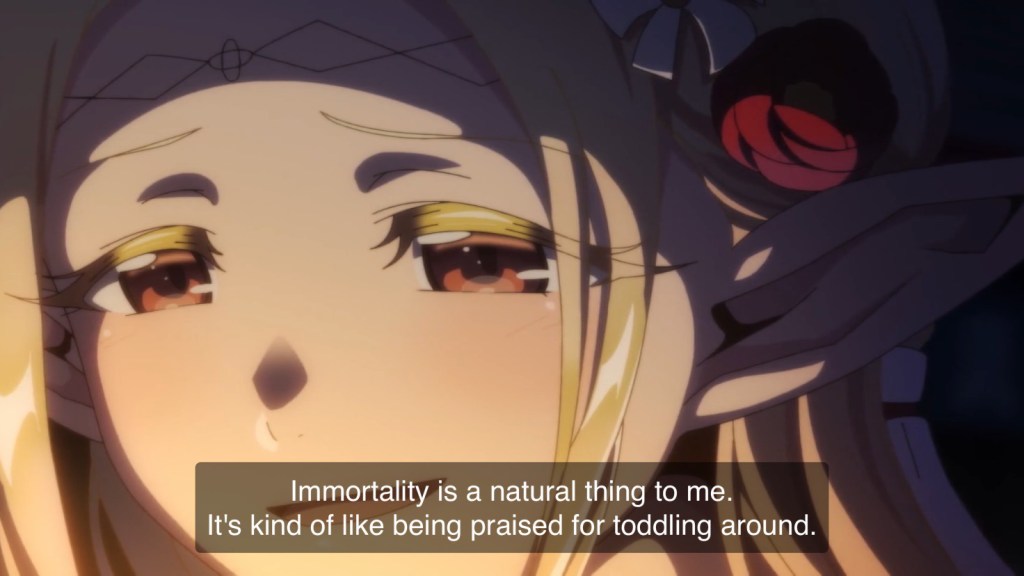
An interesting dialogue moment, and a good example of the low-key profundity in this anime.
Skip to here if you got tired of reading all that, for which I do not blame you. Throw all that out. Throw all that out. Throw it all out again. This show is fun. This show is entertaining. Above anything else, that is the most overlooked but the most important feature of an anime that exemplifies anything in anime.
Too often the academic critic loves a work the general public sees as niche or unnecessarily artsy (“artsy fartsy” is a fun if crude term, and too often apt unfortunately). I do not wish to become one of those people. But I don’t think I’m on that road here. Sure this show might not have been to everyone’s taste, but it has general appeal, both proven by its unexpected popularity and according to my view. For those that loved it, it’s fun from the minute you turn it on until it ends. I can honestly say this is the only anime I’ve instantly started rewatching the moment I finished. That more than anything will tell you how much I loved this anime. The true anime fan must not miss it.















 Anteiku Anime Reviews